Loading
JulianKent Development Stratagem LTD
  • Home
  • About
    • Our Mission
    • Why Choose JKDS
    • Feedback
  • Stratagem
  • Brokerage
  • Property Management
  • Contact
  • Click to open the search input field Click to open the search input field Search
  • Menu Menu
  • Link to WhatsApp
  • Link to Facebook

Will cutting rates fix the housing market?

Mortgage professionals are navigating one of the most challenging origination markets in recent history. Still, cutting mortgage rates would not be the end-all solution to pacify markets that many claim it to be. While lower rates might temporarily ease borrower costs or support home purchases, they would also expose the housing industry to further risk without meaningfully addressing core issues, like supply shortages or long-term affordability.

America’s housing industry is up against persistent inflation, geopolitical challenges, regulatory limbo and a wealth-driven economy increasingly sensitive to equity markets. Fear has become the driving force as investors are struggling to price risk amid looming tariffs and their potential effects on inflation.

Affordability has grown strained across many markets, with the broader economy being propped up by increasingly narrow consumer pillars. For example, just 10% of earners now drive over 50% of consumer spending. In other words, the health of the U.S. economy depends on less people, which makes for a highly fragile situation. Even a modest pullback in spending of only 20%, from the top 10% of earners, could trigger a $1.6 trillion drop in GDP, enough to tip the economy into recession. Even if that leads to eventual rate cuts, the damage to the housing ecosystem would already be done.

With current high rates, most homeowners have little reason to sell or refinance – opting instead to sit on their historically low mortgage rates from the COVID-19 era. With the notable exception of parts of Texas and Florida, this is keeping inventory tight and prices relatively firm, effectively killing the refinancing space. 

In this environment, volatility is the norm, and uncertainty has become the new operating condition. For a problem-solving mindset amidst uncertainty, policymakers must avoid short-term thinking. What seems like relief in the immediate could backfire in the long-term, because the risk extends beyond economics, it’s now psychological. In this environment, confidence and consistency from institutions like the Federal Reserve (Fed) matter just as much as the policy itself.

The current assumption is that if the Fed cuts interest rates, lenders will see relief. That approach overlooks a key fact: the Fed doesn’t directly control mortgage rates (unless it’s engaged in QE…which it’s not). The Fed’s primary means of influencing interest rates across the entire yield curve is by changing the Fed Funds Rate. This speeds up a rapidly slowing economy by forcing down the short-term rates, which in turn drive down the cost of borrowing for companies. But this doesn’t directly translate to relief for borrowers, especially when mortgage rates are tied more closely to long-term bond yields. For lenders, the mismatch between market expectations and rate realities might spark confusion, delay transactions, and increase exposure to risk.

To complicate matters more, if the Fed cuts rates too quickly, markets may panic about potential inflation, which in turn would send both long-term yields and mortgage rates up. 

An alternative, but equally challenging, solution emerging in response to the current environment is adjustable rate mortgages (ARMS). These are loans with interest rates that are set off of shorter term yields and can change after a certain period of time. We’ve already seen where this can lead in Canada, where a wave of ARM lending during the COVID-19 era triggered serious financial stress for both borrowers and lenders after rates reset much higher. So, while lower short-term rates could drive a large increase in variable rate mortgage rate production, that introduces systemic risk into a housing market that we might have to deal with 5 or 7 years from now.

As painful as this might be to read, the long term solution for affordability and inventory constraints could simply be, drum roll please, “Time”.  Time for real (i.e. inflation-adjusted) incomes to grow, time for home prices to stagnate for several years, time for builders to add supply, time for regulations to become less onerous, and time for IMB’s to implement the kind of automation that will enhance productivity and reduce borrowing costs.

In summary, short-term solutions being proposed will not resolve the uncertainty of the United States’ market conditions or protect lenders from volatility. This coming chapter calls for patience and persistence. There are far too many variables at play, and no one can claim to know where the market is headed. The best thing lenders can do right now is to prepare to weather the storm with a constant eye on costs, with a strong enough value proposition to continuously gain market share, and to take a “fast follower” approach to automation aimed at improving the consumer experience while decreasing cost to originate. So, while a drop back down to 3% mortgage rates might sound nice, a long-term mindset is going to serve the housing industry’s continued well-being more than any band-aid solution could.

Joseph Panebianco is the CEO & President, AnnieMac Home Mortgage

This column does not necessarily reflect the opinion of HousingWire’s editorial department and its owners.To contact the editor responsible for this piece: zeb@hwmedia.com.

May 17, 2025/0 Comments/by JKents
https://www.juliankent.com/wp-content/uploads/2025/11/logo.png 0 0 JKents https://www.juliankent.com/wp-content/uploads/2025/11/logo.png JKents2025-05-17 12:05:112025-05-17 12:05:11Will cutting rates fix the housing market?

Lead with Fire: A soulful series for real estate game changers

“Lead with Fire” is a transformative series created by Debra Trappen and designed for the soulful, visionary humans in the real estate industry who are done with the old playbook and ready to redefine success on their own terms.

May 17, 2025/0 Comments/by JKents
https://www.juliankent.com/wp-content/uploads/2025/11/logo.png 0 0 JKents https://www.juliankent.com/wp-content/uploads/2025/11/logo.png JKents2025-05-17 00:01:112025-05-17 00:01:11Lead with Fire: A soulful series for real estate game changers

Keller Williams isn’t slowing down on inclusion: Natalie Davis

Newly minted Keller Williams Head of Community Growth Natalie Davis talks about diversity and how childlike curiosity is key to maintaining an inclusive brokerage culture.

May 17, 2025/0 Comments/by JKents
https://www.juliankent.com/wp-content/uploads/2025/11/logo.png 0 0 JKents https://www.juliankent.com/wp-content/uploads/2025/11/logo.png JKents2025-05-17 00:01:112025-05-17 00:01:11Keller Williams isn’t slowing down on inclusion: Natalie Davis

Inman On Tour Returns to Texas on Oct. 9, 2025

Inman On Tour Texas is back for 2025, bringing together the industry’s top agents, brokers and thought leaders for a one-of-a-kind event.

May 17, 2025/0 Comments/by JKents
https://www.juliankent.com/wp-content/uploads/2025/11/logo.png 0 0 JKents https://www.juliankent.com/wp-content/uploads/2025/11/logo.png JKents2025-05-17 00:01:112025-05-17 00:01:11Inman On Tour Returns to Texas on Oct. 9, 2025

Mayor Adams is bringing the tax lien sale back. Here’s how to get your property off the list

If you’re an owner who has fallen behind on your bills for property taxes, water, sewer, or for emergency repairs, or you’re a renter who lives in a building where the owner is delinquent on the same charges, the clock is ticking.

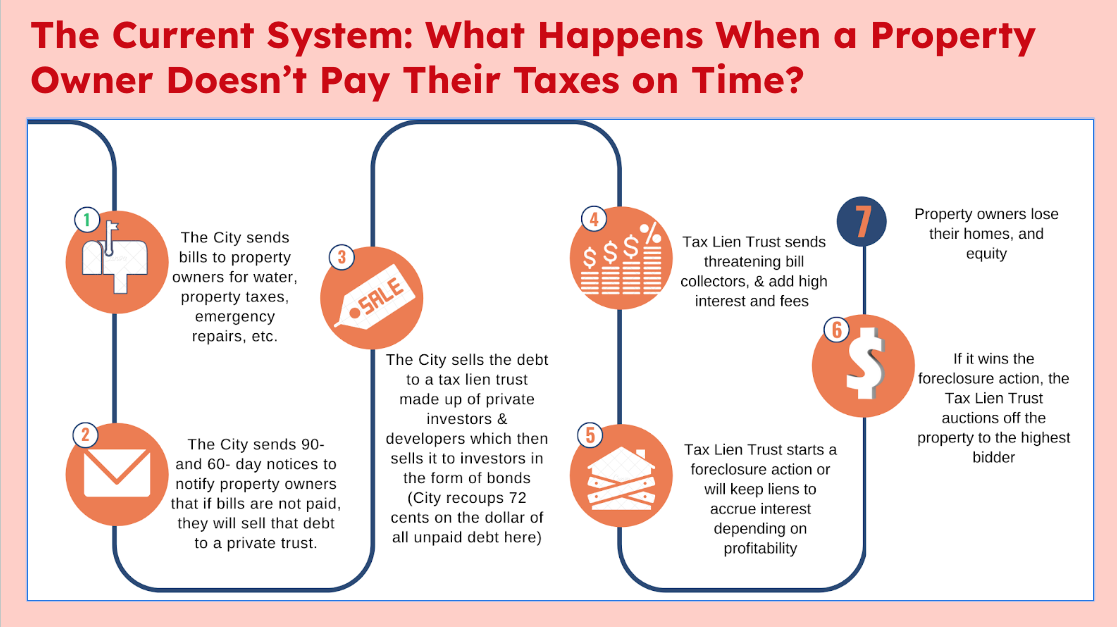
For the first time since 2021, Mayor Eric Adams is gearing up to hold a tax lien sale, a 1996 creation of the Giuliani administration that outsources the collection of unpaid property taxes and other housing bills. The sale enables owners’ debts to be sold to private investors who tack on high interest and fees and go after you for the inflated amount. If you do not pay, you can ultimately lose your property in a foreclosure auction.


[Editor’s note: A previous version of this article ran in March 2025. We are presenting it again in case you missed it.]


As of late March, 21,372 residential properties citywide were on the list—that’s down from the 90-day list of 24,017 for properties in Class 1 (one- to three-unit houses) and Class 2 (co-op, condo and rental buildings with four-plus units).

Housing advocates said it’s critical for owners on the list to act before their liens are sold. Warning notices are sent in the mail 90, 60, 30, and 10 days before the sale to notify owners that if bills are not paid, the debt will be sold to a private trust.

“We see a lot of people on the lien sale list who shouldn’t be there,” said Rachel Geballe, a supervising attorney with the Neighborhood Economic Justice Project of Legal Services NYC’s Brooklyn office. These may be owners who are entitled to an exemption because they are a senior, veteran, or have a disability.

Owners can lose their exemptions “because you have to recertify and they struggle with paperwork. Many who come to us are eligible to be removed, but a lot has to happen to get off the list,” Geballe said.

How NYC tax lien sales put properties at risk

Credit

Abolish the NYC Lien Sale Coalition

How the lien sale operates

The sale process involves the City of New York pooling eligible liens and transferring ownership to a trust; the trust (whose sole beneficiary is NYC) then uses bill collectors to go after the debts. The trust uses funds raised from bond sales to investors to buy the city’s liens at a discount. In the past the discount has been about 72 cents on the dollar, according to a 2024 report from Center for NYC Neighborhoods.

“By transferring the ownership of its liens to a trust via a bulk sale, the bonds used to purchase the liens are more appealing to investors, but that comes at the expense of oversight and accountability to ordinary New Yorkers,” the report noted. “This system was originally put into place to circumvent the city’s debt limit concerns and is no longer relevant today, yet still impact New York City’s most vulnerable homeowners.”

Pro Tip
Pro Tip:

Want to see the public records of your building in one unified report? Check out the Brick Report, our background check on any address in New York City.

Why is the tax lien sale problematic?

Once a tax lien is sold, a third-party collection agency can add fees and annual interest of up to 18 percent, compounded daily. That means owners who face liens can fall even farther behind. Next the tax lien trust can start a foreclosure action; if it wins it can auction the property to the highest bidder.

The tax lien sale has been shown to disproportionately impact owners in communities of color and lower-income communities.

A report by the Coalition for Affordable Homes found nearly two-thirds of the lien sales sold in the 2021 sale were in areas where over half of owners identified as non-white or Hispanic. Over one-fourth of the lien sales were in areas where owners reported incomes of less than $75,000.

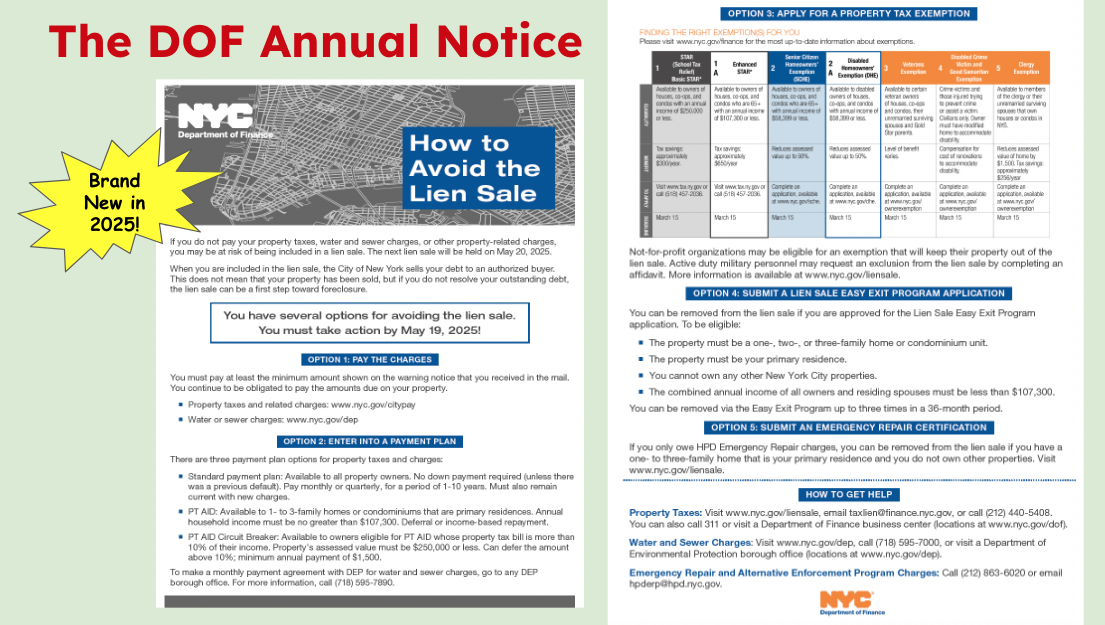
Department of Finance tax lien sale notice

Caption

A Department of Finance tax lien sale notification.

Credit

Abolish the NYC Lien Sale Coalition

Unaware they are on the list

Some owners may not be aware they are on the tax lien sale list, said Kevin Wolfe, deputy director of advocacy and public affairs at Center for NYC Neighborhoods. That’s because this is the first time the sale is being held since the pandemic, and owners who received a notice in the mail may not understand its significance, he said. (The lien sale was paused in 2020.)

A disproportionate number of small owners are represented on the list, 42 percent, even though that number reflects 20 percent of total buildings, Wolfe said.

He said owners on the list typically have paid off a mortgage or have a reverse mortgage and are often seniors—or their heirs.

“They’re not used to receiving notices from the city,” he said.

When liens are issued

Owners who are behind on their property taxes, water bills, or emergency repair bills—for example if tenants lacked heat and the city replaced the boiler—can be put on the list.​​

According to Center for NYC Neighborhoods, for one-family houses, a tax lien can be sold if an owner has sustained a debt of at least $5,000 for over three years. If you only owe water/sewer charges, but not property taxes, the city cannot sell a lien on your property; however, DEP may terminate your water/sewer service if the charges remain delinquent.

For two- to three-family homes, condo and co-op buildings, a tax lien can be sold if an owner has sustained a debt of at least $5,000 and those charges are three years overdue. A water or sewer lien of at least $3,000 can also be sold if those charges are one year overdue.

How you can get off the tax lien sale list

The Abolish the NYC Lien Sale Coalition, a group of 10 housing advocacy groups and community land trusts, is sounding the alarm about the harms perpetuated by tax lien sale and multiple options that owners can use to remove themselves from the tax lien sale list. The group is holding community briefings to get the word out; the next one is scheduled for April 3rd at 6 p.m.

The coalition was successful in getting legislative reforms passed in the City Council last year to reduce the list. For example, households that make less than $107,300 in 2025 can now use the Easy Exit form to have the property removed from the lien sale three times in 36 months.

Other new options include deferring city debt or making income-based payments through Property Tax and Interest Deferral Programs (PT AID) as well as the senior citizen homeowners exemption (SCHE), disabled homeowners exemption (DHE), veterans exemption, or not-for-profit exemption.

Ultimately, the coalition wants the lien sale to be abolished.

“We’ve been shrinking the lien sale. My hope is that the city thinks eventually that it’s not worth it, but I’m not holding my breath,” said Paula Segal, senior staff attorney in the Equitable Neighborhoods practice at TakeRoot Justice, during a recent community presentation.

In a phone conversation with Brick, Segal noted that Mayor Adams was bringing back the lien sale after four years, even though the city could have created a new system for debt collection instead of outsourcing the process again and making money for investors. His budget office estimates bringing in $80 million each year over the next four years from the lien sale.

“Peanuts,” Segal said.

During a City Council hearing in June on a bill to implement reforms to the tax lien sale, City Council member Justin L. Brannan noted, “the Council has been and remains willing to let authorization for the lien sale expire rather than collect funds at the expense of driving foreclosure and homelessness among our most vulnerable.”

‘Phone book for speculators’

One change Segal would like to see is to end the public release of the lien list, which she called a “phone book for speculators.”

That’s because it readily identifies vulnerable and desperate owners to con artists. Intro 783-2024 is a City Council bill that would record debt without a need for the lien sale and replace the public lien list with individual recordings in ACRIS, the city’s property database.

To Geballe, “it’s one of the worst things about the lien sale—publishing the names of everyone who is behind on their bills.” She advises owners who are facing liens that they are going to get a lot of calls and that they should only accept help from trusted sources.

“Any offer of help in exchange for money is a scam,” she said. In 2024, $2 million a year in public funding was set aside for outreach and free legal counseling for owners and tenants affected by the lien sale through the Center for NYC Neighborhoods.

There are numerous ways off the lien list, and getting the right help can make a critical difference.

Geballe said she had an elderly client who was also blind and had fallen behind on payments. Instead of being given an exemption, she had been put in a payment program she couldn’t afford.

She was on her way to losing her property, but a legal services attorney was able to straighten matters with the Department of Finance in time and get the sale of her lien out of foreclosure, which saved her property.

What you should do if you’re a renter

Renters can also be displaced by the lien sale. This scenario typically involves landlords who collect rents but do not pay their bills and ignore fines—they are betting on selling for a large sum—and they end up on the lien sale list

A new reform requires NYC’s Department of Housing Preservation and Development to do direct outreach to tenants in buildings that have landed on the lien list.

In addition, rental buildings that are in distress are supposed to be taken out of the lien sale. If there are problems in your rental building, contact HPD through 311 to file a complaint. This will help the city flag your building.

The coalition is pushing for legislation that would enact a city foreclosure program to protect tenants in rental buildings with negligent landlords by replacing the landlords and creating co-op conversion opportunities.

Bottom line

If you got a lien notice in the mail, don’t ignore it. You can:
1) Pay what you owe. For property taxes and emergency repair charges, go to CityPay. For water or sewer charges, go to DEP’s website.
2) Get on a payment plan. There are three options: Standard payment plan for all property owners, regardless of age or income; PT AID payment plan if you earn $107,300 or less per year and meet other requirements, or PT AID Circuit Breaker payment plan if you meet the income cap above and your property tax bill is more than 10 percent of your income and your property’s assessed value is $250,000 or less. If you are approved for one of these plans, you may also be eligible to pay a reduced interest rate.
3) Apply for an exemption: senior citizen homeowners exemption (SCHE), disabled homeowners exemption (DHE), veterans exemption, or a not-for-profit exemption.
4) Apply for an Easy Exit.
5) File an emergency repair certification.

You Might Also Like


May 17, 2025/0 Comments/by JKents
https://www.juliankent.com/wp-content/uploads/2025/11/logo.png 0 0 JKents https://www.juliankent.com/wp-content/uploads/2025/11/logo.png JKents2025-05-17 00:01:112025-05-17 00:01:11Mayor Adams is bringing the tax lien sale back. Here’s how to get your property off the list

Redfin shareholder sues for more information on Rocket merger

Lawsuit seeks class action status to represent Redfin shareholders, claiming they need more information about financial advisor’s potential conflict of interest before June 4 merger vote.

May 17, 2025/0 Comments/by JKents
https://www.juliankent.com/wp-content/uploads/2025/11/logo.png 0 0 JKents https://www.juliankent.com/wp-content/uploads/2025/11/logo.png JKents2025-05-17 00:01:112025-05-17 00:01:11Redfin shareholder sues for more information on Rocket merger

Serhant’s diss, Homes.com’s boost, Caballero’s record: Top 5

Looking for a quick catch-up on the buzziest stories of the week? Here’s Inman Top 5, the most essential stories, according to Inman readers.

May 17, 2025/0 Comments/by JKents
https://www.juliankent.com/wp-content/uploads/2025/11/logo.png 0 0 JKents https://www.juliankent.com/wp-content/uploads/2025/11/logo.png JKents2025-05-17 00:01:112025-05-17 00:01:11Serhant’s diss, Homes.com’s boost, Caballero’s record: Top 5

Fed: Requiring buyer agreements has no effect on commissions

The Federal Reserve analysis found that rising home prices are likely why commission rates fell in the past two decades, but found no impact on rates after buyer contracts were required in 15 states.

May 17, 2025/0 Comments/by JKents
https://www.juliankent.com/wp-content/uploads/2025/11/logo.png 0 0 JKents https://www.juliankent.com/wp-content/uploads/2025/11/logo.png JKents2025-05-17 00:01:112025-05-17 00:01:11Fed: Requiring buyer agreements has no effect on commissions

Builders pull back from new construction once again in April

April’s housing data underscores a challenging landscape for new construction, particularly in the single-family segment, and the privately-owned segment isn’t far behind.

May 17, 2025/0 Comments/by JKents
https://www.juliankent.com/wp-content/uploads/2025/11/logo.png 0 0 JKents https://www.juliankent.com/wp-content/uploads/2025/11/logo.png JKents2025-05-17 00:01:102025-05-17 00:01:10Builders pull back from new construction once again in April

The market is short 416K homes for middle-class homebuyers: NAR

After a herky-jerky few years, the housing market is at a major tipping point, according to the National Association of Realtors’ May 2025 Housing and Affordability Report. The report, which is based on NAR and Realtor.com data, revealed the market needs at least 416,000 listings priced at or below $225,000 to make homeownership affordable to the typical middle-class household.

May 17, 2025/0 Comments/by JKents
https://www.juliankent.com/wp-content/uploads/2025/11/logo.png 0 0 JKents https://www.juliankent.com/wp-content/uploads/2025/11/logo.png JKents2025-05-17 00:01:102025-05-17 00:01:10The market is short 416K homes for middle-class homebuyers: NAR
Page 49 of 105«‹4748495051›»
Search Search
  • Modern Single EntryJuly 15, 2015 - 3:48 pm
  • Classic Single EntryJuly 15, 2015 - 3:48 pm
  • Classic Single Entry #2July 15, 2015 - 3:46 pm
  • MacBook PRO & SSDJuly 15, 2015 - 3:41 pm

Categories

  • No categories

JKDS is a licensed New York State real estate brokerage firm. #10351200205

Interesting Links

  • Stratagem
  • Brokerage
  • Property Management
  • Contact

Where to find us

347 Fifth Avenue
Suite 1402
New York, 10016
Phone: +1.888.559.5333

Our Office Hours

Monday-Friday: 7:00-19:00
Saturday: 10:00-17:00
Sunday: 12:00-16:00

© Copyright - JulianKent Development Stratagem LTD
  • Privacy Policy
  • Terms of Use
Scroll to top Scroll to top Scroll to top

This site uses cookies. By continuing to browse the site, you are agreeing to our use of cookies.

AcceptCloseSettings

Cookie and Privacy Settings


How we use cookies

We may request cookies to be set on your device. We use cookies to let us know when you visit our websites, how you interact with us, to enrich your user experience, and to customize your relationship with our website.

Click on the different category headings to find out more. You can also change some of your preferences. Note that blocking some types of cookies may impact your experience on our websites and the services we are able to offer.

Essential Website Cookies

These cookies are strictly necessary to provide you with services available through our website and to use some of its features.

Because these cookies are strictly necessary to deliver the website, refusing them will have impact how our site functions. You always can block or delete cookies by changing your browser settings and force blocking all cookies on this website. But this will always prompt you to accept/refuse cookies when revisiting our site.

We fully respect if you want to refuse cookies but to avoid asking you again and again kindly allow us to store a cookie for that. You are free to opt out any time or opt in for other cookies to get a better experience. If you refuse cookies we will remove all set cookies in our domain.

We provide you with a list of stored cookies on your computer in our domain so you can check what we stored. Due to security reasons we are not able to show or modify cookies from other domains. You can check these in your browser security settings.

Other external services

We also use different external services like Google Webfonts, Google Maps, and external Video providers. Since these providers may collect personal data like your IP address we allow you to block them here. Please be aware that this might heavily reduce the functionality and appearance of our site. Changes will take effect once you reload the page.

Google Webfont Settings:

Google Map Settings:

Google reCaptcha Settings:

Vimeo and Youtube video embeds:

Privacy Policy

You can read about our cookies and privacy settings in detail on our Privacy Policy Page.

Privacy Policy
Accept settingsClose