

Turn one room into two: The insider’s guide to temporary pressurized walls
Renting in New York City always causes sticker shock, especially now that the city is experiencing record-breaking rents. So if you are a recent college grad or young professional, your strategy might be to divide and conquer an apartment—and squeeze in a roommate or three—to turn a place you can’t afford into one that you can.
One of the ways to do this is to put up a temporary pressurized wall, transforming a one-bedroom apartment into a two bedroom (or a two-bedroom unit into a three bedroom).
Using a temporary pressurized wall—one that is not permanently attached to the existing walls or floor and doesn’t interfere with the ventilation or sprinkler systems or block exit routes—is a popular strategy to add a legal bedroom for apartment shares or families. You can also use a pressurized wall to create a nursery or even a home office if you work remotely.
[Editor’s note: A previous version of the article ran in June 2023. We are presenting it again here with updated information for May 2025.]
Because adding a temporary pressurized wall can change an apartment’s layout, you or your landlord may need to get a permit from the Department of Buildings (see more on this below). This involves hiring an architect, drawing up plans, and getting the plans approved—a policy that has been increasingly enforced over the last several years.
As a result, many (some might say most) landlords and management companies prohibit temporary walls. In these buildings, you can still explore other solutions, such as installing bookshelf walls that stop at least one foot from the ceiling and are considered furniture. There are also curtain room dividers that are reinforced to block out sound. Neither of these requires permits (or even permission).
But if those solutions don’t suffice, you have two options: seek out a different building or try and work with your existing landlord.
“Most of my clients still prefer pressurized walls,” said Donny Zanger, owner of All Week Walls. “They are adults who are looking for real privacy, and pressurized walls are still the best way to achieve that.” (Zanger started the company because he needed a way to afford his own rent.)
Here’s what you need to know about using a temporary pressurized wall safely, and a round-up of the companies that sell and install them.
What defines a temporary pressurized wall?
Temporary walls are non-load-bearing (they do not support the ceiling) and are not permanently attached to other walls or the floor. As such, they are able to be installed and removed without causing damage to other permanent walls—no nails, screws, or other fasteners required.
They are around five inches thick, give or take a few centimeters, and can support up to 25 or 30 pounds; you can usually pay extra to have the wall reinforced for mounting a flat-screen TV or other heavy objects.
You can also add soundproofing, which is described as offering about the same noise barrier as real walls.
When planning to put up a temporary pressurized wall, it is important that this wall not block exit routes or interfere with your apartment’s ventilation or sprinkler systems.
Note that these walls offer (much) more sound insulation and privacy than walls that do not extend to the ceiling or are free-standing.
Do I need a DOB permit?
The answer here is maybe. According to Andrew Rudansky, press secretary at NYC’s Department of Buildings, the DOB doesn’t differentiate between pressurized or temporary walls and “regular” walls when it comes to permitting requirements, so you still need to follow some rules.
Rudansky said that if a floor-to-ceiling divider is added to an existing space and changes the layout of a dwelling, permits might be required because of egress, light, and ventilation issues. “There is no definitive answer for whether a project that adds a wall needs a permit or not because every renovation project is different,” he said.
He recommends consulting a design professional, like an architect or contractor, or contacting the DOB directly to see if your project requires permits and approvals. When contacting the DOB directly, be sure to call the borough office where your apartment is located.
Another way to get feedback is to attend the DOB’s weekly open houses every Tuesday from 4 to 7 p.m. your local borough office. At these “Buildings After Hours” events, you can receive one-on-one attention.
Another important consideration when adding a temporary wall is making sure that any new bedroom is legal. Specifically, it must be a minimum of eight square feet in length or width and at least 80 square feet—meaning you can’t turn a long, skinny space into a legit bedroom. It must also include a window that faces outside for natural light and offers a means of escape in an emergency (so no air shafts). Pass-through bedrooms are not allowed.
How to get the necessary approval
If adding a wall to create a room is the only way to make an apartment work for you, make doubly sure that it is permissible by the landlord. Always check directly with management—not your real estate agent—before you sign a new lease.
Try to have the owner confirm it in writing. Some buildings can be vague about what they allow, so make sure you specify pressurized walls that extend to the ceiling.
On the bright side, a growing number of building owners recognize that allowing pressurized walls gives them an edge over those that require a 12-inch gap or other loopholes. And in some cases, the longer the lease, the more amenable the landlord may be.
If you are searching for a new place, look for listings with “wall shares allowed” and rule out any that say “no pressurized walls.”
Even landlords who allow temporary walls may only permit certain styles or require you to work with a specific wall company. Note that most wall companies have forms and specs on their website to make it easy for you to weigh the options with your landlord. These companies are also used to working with buildings and can help smooth out the process.
Need help finding a rental that allows temporary walls? The rental experts at The Agency, a Brick Underground partner, know exactly where to look. If you sign up here, you can also take advantage of The Agency’s corporate relocation rate—where you’ll pay a broker’s fee of 10 percent of a year’s rent instead of the usual 12 to 15 percent on open listings. Bonus: The agents at The Agency are a delight to deal with.
How much to budget for
The whole idea behind these temporary walls is to help make your rent more affordable. If you and your roommate are signing a new lease, you may be planning to split the cost of the temporary wall installation. Explore the different companies and features to find the most cost-efficient solution using the following tips. Be sure to get all the costs and other details in writing, and read the fine print to avoid any surprises.
-
Prices for temporary walls from the companies below range from $700 to over $3,000, depending on ceiling height, added features, and any custom requests.
-
Add-on features vary among companies, but different door styles (sliding, pocket, standard, and single- or double-pane French doors) and windows are common and available in different sizes.
-
Prefabricated walls with seams tend to be cheaper and quicker to make and install, though seamless walls blend in better with permanent walls and the ceiling and look more like traditional walls.
-
Some companies lease the walls for a specified time frame (usually two to three years), after which a renewal fee is required. Others let you purchase the wall outright (a good option for long-term renters). None of the companies contacted require a deposit.
-
All companies will remove the wall for no extra charge within a time specified in the lease or purchase agreement and with advance notice. Make sure you know what your company requires from the get-go.
-
Before the company arrives, make sure you reserve the service elevator if there is one (walk-ups may cost extra); clear out four feet of space on either side of the wall.
-
The walls are painted white unless you request a custom color, in which case you will need to buy the paint yourself and let the company know in advance.
-
Plan for anywhere from four to eight hours for the installation, and to be there to let them in (or make plans for the building to allow access), and also at the end, to make sure it all looks as planned.
-
Payment is required on the day of installation, usually once the wall is in place. Unless otherwise noted, all the companies listed below accept cash, checks, credit cards, and PayPal.
-
Make sure your landlord gives approval before the company arrives—and never schedule the installation on the day your moving company will be unloading your boxes.
Here are four of the more well-established wall companies that work in NYC, listed in alphabetical order.
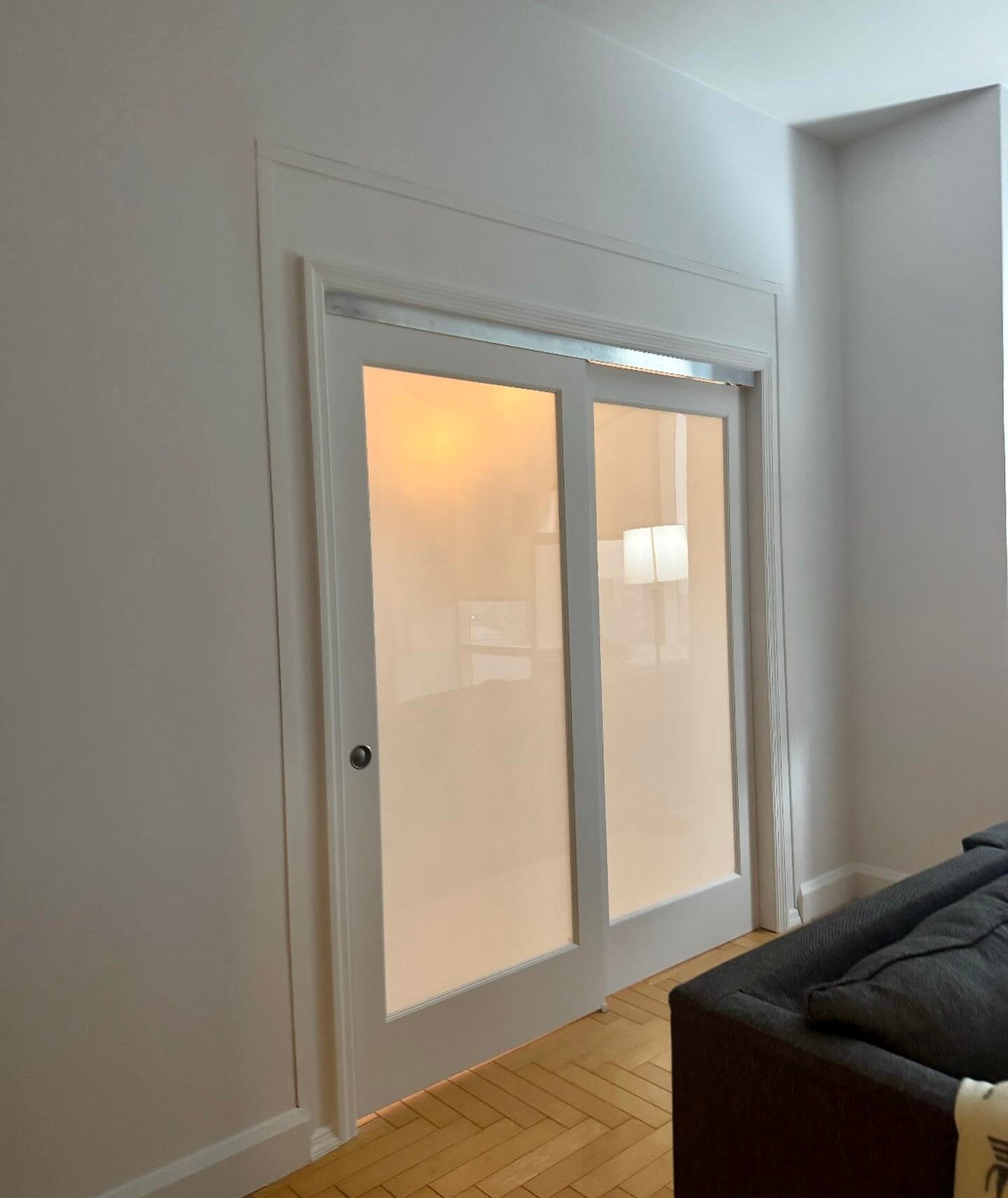
A similar setup with a frosted sliding door by All Week Walls ranges from $2,500 to $3,500.
All Week Walls
1. All Week Walls
As the oldest pressurized wall company in NYC, All Week Walls has “over 15 years of experience and over 5,000 walls built,” according to its website, and a solid reputation in NYC for its customer service and quality products. They will even work weekends, a rarity among wall companies.
Temporary walls run from $700 to $2,000, depending on the finish and features. “Most customers want multiple walls, such as T-configurations and also a seamless look, all of which push up the price,” Zanger said. He also recommends adding soundproofing for more privacy (at an additional cost).
Removal is included within the first year and with at least 30-days’ notice; otherwise, it will cost $850.
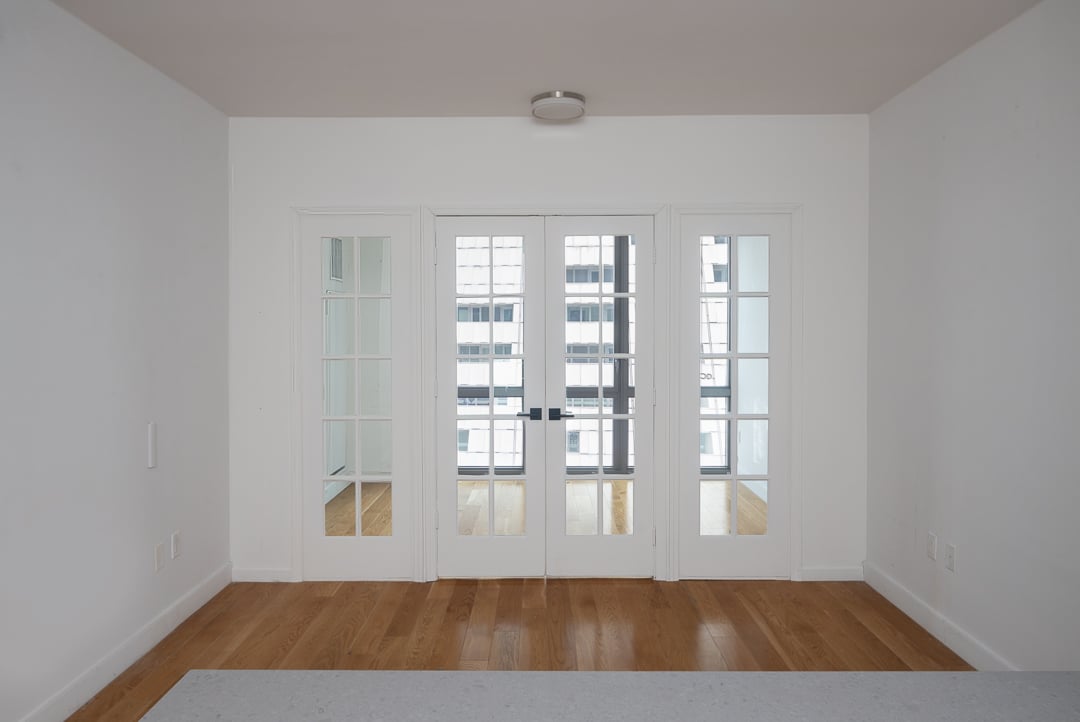
A wall like this one from MPW, which includes French doors and two plexiglass panels, costs around $2,500.
Manhattan Pressurized Walls
2. Manhattan Pressurized Walls
Manhattan Pressurized Walls (aka MPW), in business since 2004, is what at least a handful of management companies report as their company of choice.
Prices start at around $1,200 for an eight-by-10-foot seamless pressurized wall with a standard swinging door and go up from there depending on additional costs for different doors and other features. MPW offers extra soundproofing options to make the temporary walls as noise-tampering as regular walls.
All MPW temporary walls are painted with two coats of Benjamin Moore paint in your choice of white, China white, linen white, or white dove in a flat finish. Custom colors and finishes are also possible and will be charged accordingly, or you can paint the walls yourself.
The lease term is two years, with an option to renew for an undisclosed amount (it will be specified in the lease agreement). Unless you provide at least four weeks’ notice, the cost of removal during the lease period is $420.
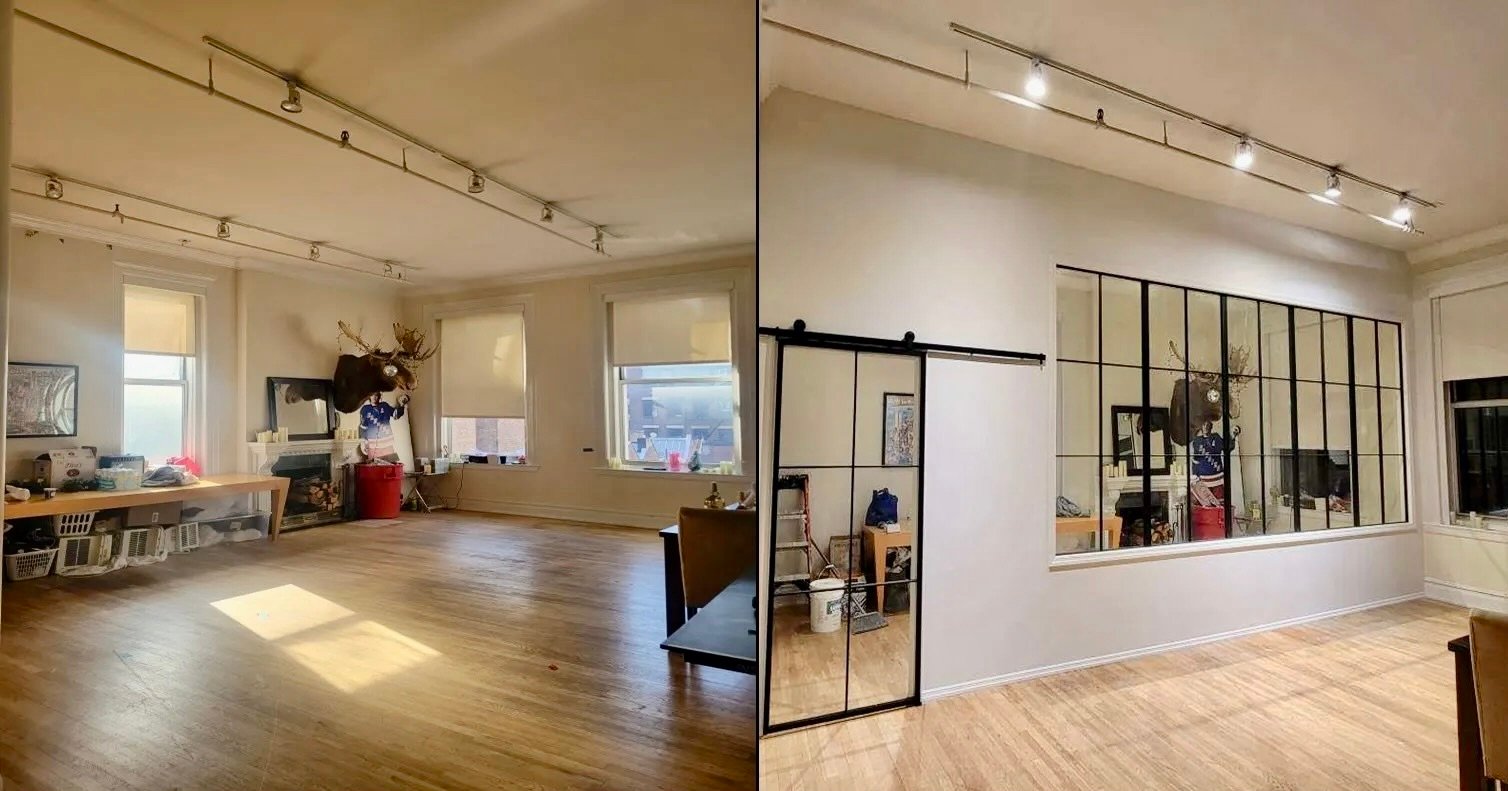
A wall with a black casement-style barn door and window by 1DayWall; pricing available upon request.
1DayWall
3. 1DayWall
1DayWall (affiliated with NYC Interior Remodeling) builds temporary walls that range from about $875 to $2,500. Their standard wall is 4.75 inches thick, and unlike the other companies listed here, they also offer upon request, a three-inch-thick wall (which is helpful in especially tight spaces).
In addition to standard (swing), sliding, and French doors, 1DayWall offers custom, black-framed, casement-style doors for a modern look.
The walls are painted flat white using Benjamin Moore Super Hide paint (the default of most NYC rentals); custom colors will cost extra and must be provided by the client. Although the company claims the walls are “quite noise resistant,” it will add more sound insulation upon request.
The wall can be removed for a one-time fee of $350 plus tax. The company only accepts a certified check.
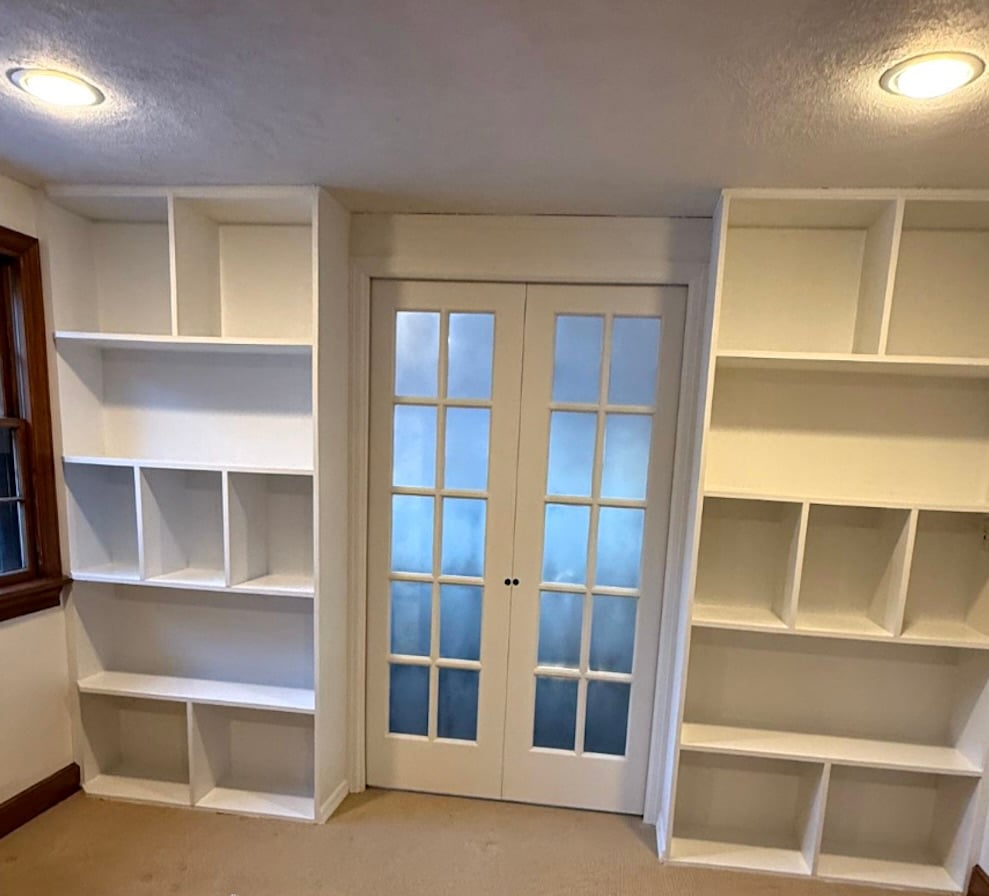
A customized temporary wall with bookshelves by Wall 2 Wall NY; pricing available upon request.
Wall 2 Wall NY
4. Wall 2 Wall NY
Founded in 2012, Wall 2 Wall was named “Best of NYC 2019″ in its category by New York Magazine. It is also the go-to company for many landlords throughout the five boroughs.
“As a high-volume company, we have relationships with practically every building in NYC and know what’s allowed and what’s not,” said owner Eddie Sapienza.
The price of the most basic wall with a swinging door is $1,125 for clients on a budget. But Sapienza said he will build anything a client wants, “including a wall with double-frosted French doors in the center and lighted plexiglass windows on either side.”
Wall 2 Wall also guarantees all mechanical parts, such as hinges and door tracks—but not holes punched through walls (it happens).
—Earlier versions of this article contained reporting and writing by Lucy Cohen Blatter and Donna M. Airoldi.
You Might Also Like
 JKDS is a licensed New York State real estate brokerage firm. #10351200205
Leave a Reply
Want to join the discussion?Feel free to contribute!