

New law aims to give NYC renters who served time a fair chance at housing
Hilton N. Webb Jr. struggled to find housing for years in New York City because of a criminal conviction in his past.
He had documentation that restored his rights to full citizenship, including voting, but it didn’t help him with housing. Landlords would still run criminal background checks and reject his rental applications. It was a disheartening experience.
“Once you have done your time you are supposed to be restored to society,” said Webb, who earned a master’s degree in social work at Lehman College in the Bronx.
Many renters find themselves shut out of the housing market after serving sentences. Nearly 750,000 people in NYC have a conviction record, almost 11 percent of the adult population—80 percent of whom are Black and brown, according to a report from the Data Collaborative for Justice at John Jay College of Criminal Justice.
But that appears likely to change thanks to a new law that makes it illegal for most landlords and brokers to turn down renters’ applications based solely on conviction history. The Fair Chance for Housing Act (FCHA), which went into effect on Jan. 1st, is aimed at preventing housing discrimination against renters who have a criminal conviction and served their time, a bias that contributes to housing instability and homelessness.
Webb’s experience spurred him to get involved with the Fair Chance for Housing Campaign, a coalition that worked to get the law passed.
“It is disingenuous to tell people, ‘OK, you did your time, now go back to your life,’” while denying them housing, he said. (He recently lost his job as a harm reduction mental health counselor because of the federal government shutdown and is seeking a new position.)
Reducing homelessness and housing instability
The law creates protections for New Yorkers that have never existed before, said Diane Johnston, an attorney with the Legal Action Center, which was part of the coalition that pushed for the law.
“NYC is one the most difficult markets to find housing. People who have a conviction in their history have yet another barrier. A criminal history means someone is 10 times more likely to become homeless,” Johnston said.
The law requires housing providers to vet renters’ financial fitness first: consider an applicant’s credit score, income, and tenant history—essentially pre-qualify a renter and then make a conditional offer of a lease.
How to run a criminal background check
A criminal background check, if a landlord or board chooses to do one, is supposed to take place after the credit check, and applicants must give their permission, be informed of their rights, and receive a copy of the report.
Under the new law, landlords can only consider convictions within a narrow window. They are limited to felony convictions within five years of release from incarceration or date of sentence and misdemeanor convictions within three years of release from incarceration or date of sentence.
Sex offenses are handled differently and have no time limit. Landlords can consider convictions that are registered on federal or any state sex offender registries.
Tenants have five business days to correct errors or provide information or evidence of rehabilitation.
A chance for tenants to respond
If an owner decides to reject an applicant based on their criminal background, they must do so in writing, explaining how the criminal history impacted the decision.
Tenants should be given a chance to respond, Johnston said.
In this case, they should “submit supporting information that explains who you are today and why you would be a good tenant,” she said, adding, “we encourage people to prepare this in advance.”
Renters who feel they are being discriminated against can file a complaint with the NYC Commission on Human Rights or a private lawsuit. The commission or the courts may require the housing provider to change their policies, provide compensation, or pay a penalty.
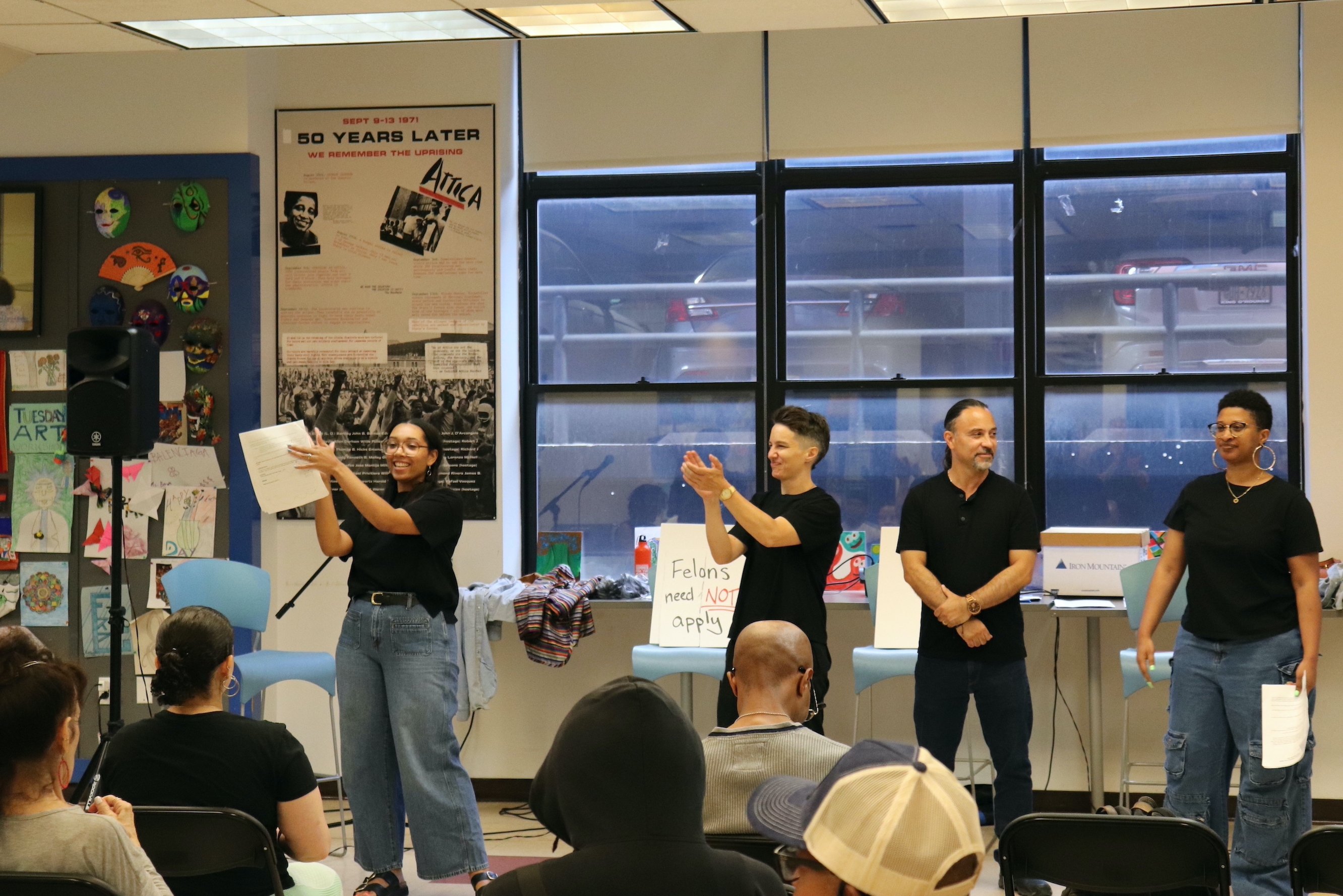
Getting a Fair Chance, a workshop on housing discrimination, was created by Caitlyn McCain (left) with Ania Upstill, Devone Nash, Eric Avilés, Hilton N. Webb, Jr., LMSW, Jaheem Jefferson, Jonathan Alexander, Kimberly Howard, Leela Cullity Younger, Liz Morgan, Mustafa Fraizer, Sincere Buggs-Greer, Tyshawn Mcgeachy, and Zakearah Young in partnership with the NYC Commission on Human Rights through the Department of Cultural Affairs’ Public Artist in Residence program.
Caitlyn McCain
Raising awareness through theater
Webb said large landlords are likely aware of the new law, but smaller mom-and-pop landlords may not know about it. And more critically, many renters “that are affected by the law don’t know about it,” he said.
Helping to spread the word is theater artist Caitlyn McCain. As NYC’s Commission on Human Rights Public Artist in Residence for 2024-2025, McCain, along with a group of justice-impacted New Yorkers, created a 90-minute performance workshop that uses storytelling and audience participation to teach New Yorkers how to use the Fair Chance for Housing Act.
Her work has been showcased by The Fortune Society with upcoming performances at other nonprofit and community-based organizations across NYC. Organizations interested in hosting a performance can contact her directly.
The production features scenes about searching for housing in NYC that illustrate how housing providers could discriminate against renters in violation of the new law.
Outreach about the new law is important, but it can be hard to understand in practical terms how the law impacts renters. McCain said she was inspired to find a way to connect with New Yorkers in a different format.
“Human rights laws can only be useful if people know how to exercise them,” McCain said. The scenes provide scripts for renters to use in their everyday lives.
She is seeking additional funding to continue the project, support human rights education, and compensate the actors, she added.
You Might Also Like
 JKDS is a licensed New York State real estate brokerage firm. #10351200205
Leave a Reply
Want to join the discussion?Feel free to contribute!