
Loading
JulianKent Development Stratagem LTD
  • Home
  • About
    • Our Mission
    • Why Choose JKDS
    • Feedback
  • Stratagem
  • Brokerage
  • Property Management
  • Contact
  • Click to open the search input field Click to open the search input field Search
  • Menu Menu
  • Link to WhatsApp
  • Link to Facebook

Is Zillow Premier Agent worth the cost?

As agents, Zillow is our best friend and worst enemy. Generally, it provides easy access to listings and gives our clients a glimpse of the market, but it can also be unrealistic with pricing, thereby giving false promises to home buyers and sellers. Either way, it is the go-to listing platform with about 227 million average monthly unique users, so having your smiling face on Zillow is a huge business opportunity.

This takes us to Zillow Premier Agent, the real estate agent-specific program created by Zillow to fuel agent pipelines with clients directly from listings on Zillow. As with other lead generation platforms, the biggest questions are: How does it work, and is the Zillow Premier Agent cost worth it for me?

After extensive research and reaching out to a few real estate agent friends, like Tom Tomasian, a diehard Zillow Premier Agent throughout his career in Massachusetts and Florida, we’ve got answers for you to determine if it’s worth the cost of becoming a Zillow Premier Agent.

What is Zillow Premier Agent?

Zillow Premier Agent is an advanced marketing and advertising program offered by Zillow that launched in 2008. At its core, Zillow Premier Agent connects agents with potential home buyers and sellers. The main goal is to enhance the visibility and reach of real estate agents.

By signing up as a Zillow Premier Agent, agents receive leads directly from Zillow based on their target zip codes, allowing them to focus on specific markets or neighborhoods. These leads are typically high-intent, as they come from users who have shown a direct interest in buying or selling property.

The value proposition of Zillow Premier Agent lies in its lead generation capabilities. Agents receive leads directly from Zillow based on their target zip codes, allowing them to focus on specific markets or neighborhoods. These leads are typically high-intent, as they come from users who have shown a direct interest in buying or selling property. In other words, ideal. Zillow Premier Agent allows you to reach a vast audience of active home buyers and sellers.

Additionally, Zillow Premier Agent includes tools for managing and nurturing leads, integrating with customer relationship management (CRM) systems and analyzing performance metrics. These resources are designed to help agents efficiently convert leads into successful transactions, thereby growing your business and market presence.

How much does Zillow Premier Agent cost? 

Now that you know the ins and outs of how it works, let’s talk about how much Zillow Premier Agent costs. Unfortunately, we can’t give you an exact number because Zillow wants to get on the phone with you to provide custom pricing based on your location.

In general, leads through Zillow Premier Agent cost between $20 and $60 per lead. However, your actual cost is determined by a few factors, most out of your control. Here are the four main factors that will determine what your cost will be:

  • Your chosen zip code 
  • Average home values
  • Number of competing agents 
  • Overall market demand 

The general rule is that the higher the property value in your zip code, the higher the Zillow leads cost. In addition, the more agents in your zip code, the smaller your share of leads, and you may need to pay more to grab a larger market share. Typically, Zillow Premier Agents pay between $300 and $500 per month in non-metro areas and $1,000 per month or more for metro areas.

How does Zillow Premier Agent work?
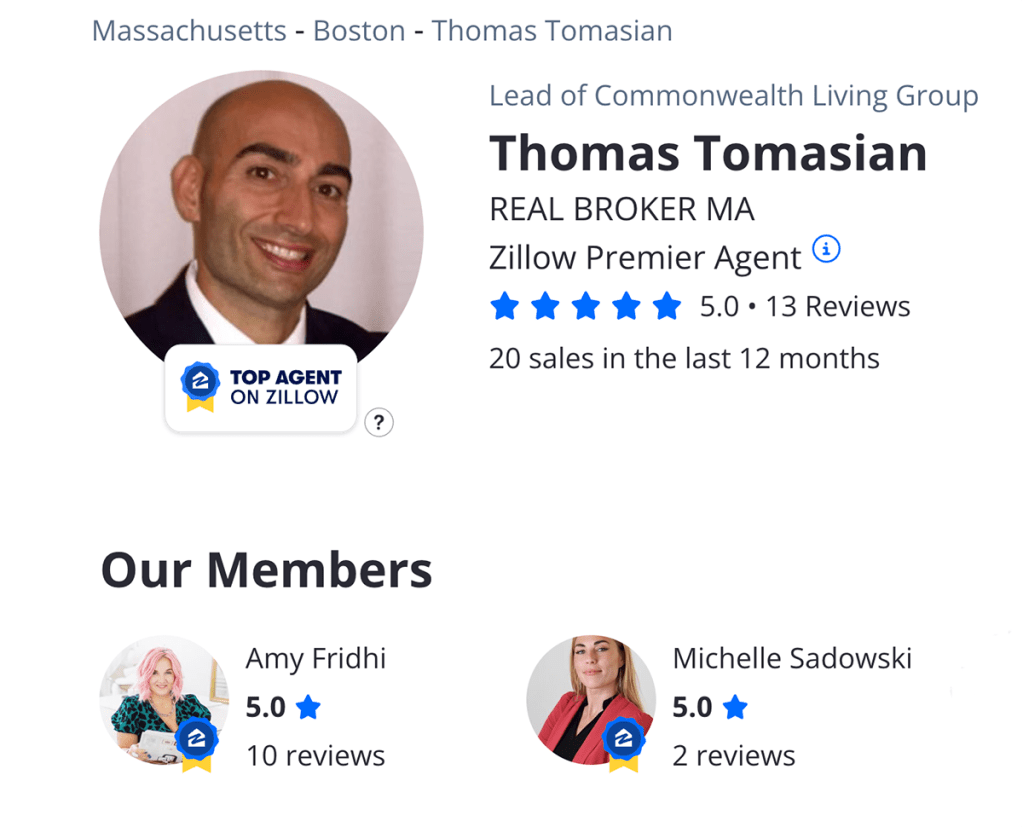
Feature of Zillow Premier Agent Thomas Tomasian and other members Amy Fridhi and Michelle Sadowski.
Example of Zillow Premier Agent feature (Source: Zillow)

When an agent signs up, they are featured as the “Premier Agent” on listings in their chosen ZIP codes. This means that your contact information and profile will be prominently displayed alongside properties you’re representing and in areas where you want to generate new business. When a potential home buyer or seller views a property listing on Zillow, they see your Premier Agent’s information and can directly contact you for more information or to schedule a showing.

Here are features that make Premier Agent work its magic:

  • Featured listings: Agents’ listings are given priority placement on Zillow and Trulia, increasing visibility to potential buyers.
  • Lead generation: The platform generates leads by connecting agents with buyers and sellers who are actively searching for homes on Zillow and its affiliate sites.
  • CRM integration: Zillow Premier Agent integrates with various CRM systems, allowing agents to effectively track and manage their interactions with leads and clients.
  • Performance analytics: The service provides detailed analytics on listing performance and lead engagement, helping agents understand their return on investment (ROI) and refine their marketing strategies.
  • Zillow Premier Agent profiles: Agents can build robust profiles with client reviews and ratings, enhancing their credibility and appeal to potential clients.
  • Exclusive advertising: Agents get exclusive advertising opportunities on Zillow and Trulia, providing them with a competitive edge in their local markets.
  • Training and resources: Zillow Premier Agent offers various educational resources, webinars and training sessions to help agents maximize their use of the platform and improve their overall real estate marketing skills. These features combine to create a powerful tool for real estate agents to increase their market presence, enhance their brand and drive more successful transactions.

Pros and cons of Zillow Premier Agent

Let’s break it down a bit further to see the pros and cons of using Premier Agent.

  • Increased exposure: Zillow is one of the largest real estate websites, offering agents a platform with a vast audience and enhancing their visibility to potential clients.
  • Targeted Advertising: Agents can select specific ZIP codes where they want to focus, allowing for targeted marketing in areas they know well or wish to grow their business.
  • Lead Generation: The platform provides a steady stream of leads from potential buyers and sellers, which can be crucial for business growth and maintaining a consistent client pipeline.
  • Tools and Analytics: Zillow Premier Agent offers various tools, including a CRM system and analytics, helping agents track, nurture and manage leads more effectively.
  • Reputation Building: With features for client reviews and ratings, agents can build their reputation online, which is increasingly important in the digital age.
  • Cost: The service can be expensive, especially in competitive markets, and may not be cost-effective for all agents, particularly those new to the industry or working in lower-cost markets.
  • Competition: Agents are often listed alongside other Premier Agents on the same listings, which can dilute the impact of their advertising and require them to work harder to stand out.
  • Quality of Leads: Not all leads provided by Zillow are high-quality; some may be early in the buying process or not serious, requiring agents to spend time qualifying leads.
  • Dependence on Platform: Heavy reliance on Zillow for leads can make agents vulnerable to changes in platform policies, pricing or market dynamics.
  • Learning Curve: Maximizing the benefits of Zillow Premier Agent requires understanding and effectively utilizing its tools and analytics, which can have a learning curve for some agents.

Alternatives for Zillow Premier Agent

We know Zillow’s lead generation is primarily for buyer leads, which are important to your pipeline. However, there are other types of leads that agents can target to build a business, plus a variety of systems that offer additional capabilities like a CRM, marketing suite, communication, etc. Here are other options to look at if Premier Agent isn’t for you:

Market Leader logo: a real estate CRM solution

Market Leader

$189/month

Targets buyers and sellers, and contains marketing and advertising capabilities

Visit Market Leader

Logo-Smartzip

Smartzip

~$500/month

Targets sellers with predictive analytics

Visit Smartzip

Logo-Redx

REDX

$50/month

Targets niche leads, i.e. expired, foreclosure, FSBO, FRBO

Visit REDX

Related articles


FeaturedImage-buy-real-estate-leads


8 best places to buy real estate leads in 2025


FeaturedImage-top-real-estate-lead-generation-companies


The 8 top real estate lead generation companies for 2025

FAQs

How do I get out of a Zillow Premier Agent contract?

If you’re on a month-to-month agreement with Zillow, you can cancel your subscription at any time. If you have a current contract, you can cancel it before the end of the current term, but you will be charged an early termination fee. The fee will be twice the monthly minimum spend outlined in your contract.

Can you remove a bad review on Zillow?

You cannot remove a bad Zillow review, but you can respond to it. However, if there is inappropriate content on the review, you can flag it with Zillow for their moderators to review and remove it.

Are paid leads worth the money?

This all depends on your lead generation strategy, but paid leads definitely do save time and effort, which does equate to your money and ROI. In that respect, paying for leads and getting to work them immediately is worth it for a lot of agents. However, if your budget does not allow for the additional spend at the moment, there are certainly free, organic ways to capture leads.

Related article


FeaturedImage-real-estate-lead-generation-ideas


15 real estate lead generation ideas (+ expert tips & tools)

The full picture: Is Zillow Premier Agent worth it?

The question of the day! And the answer: it depends on what you’re trying to achieve, and if you’re willing to work within the Zillow system consistently. Zillow Premier Agent works best for agents who:

  • Seek to expand their online presence and lead generation in specific markets.
  • Have a strong understanding of their local real estate market and want to target potential clients actively searching for homes in those areas.
  • Want to leverage Zillow’s extensive user base to boost their listings’ visibility.
  • Aim to establish themselves in competitive markets.
  • Are adept at online communication and can promptly respond to inquiries.
  • Are willing to invest in marketing and understand the value of online platforms in today’s digital-first real estate environment. 

On the other hand, Premier Agent might not be the best option for agents who:

  • Want to focus on seller or niche leads, like expired, foreclosure, etc. 
  • Are in saturated markets, as it may cost more for leads in areas where multiple Premier Agents already have claimed territory.
  • Do not have a firm grasp on communication strategies; it would be best to hone those skills before spending money on Zillow. 
  • Have zero experience talking to clients; you’ll be required to reach out to leads who inquire about listings, so practice having initial qualifying conversations before using Premier Agent.

Zillow Premier Agent is an industry leader for a reason. The agents who use it successfully understand the nuances of the CRM, the urgency of responding to leads and the importance of having a solid online profile when buyers and sellers are online shopping.

As with all things real estate marketing, only you can decide if Zillow Premier Agent is worth it. If you think you are up for the challenge, then investing in Zillow Premier Agent may be the thing you need to level up in your real estate business.

Real estate advice + top tech, lead gen & marketing tools — delivered to your inbox.

Get expert advice, independent reviews and product recommendations from our editorial team of experienced real estate agents, brokers and coaches.

September 4, 2025/0 Comments/by JKents
https://www.juliankent.com/wp-content/uploads/2025/11/logo.png 0 0 JKents https://www.juliankent.com/wp-content/uploads/2025/11/logo.png JKents2025-09-04 00:00:432025-09-04 00:00:43Is Zillow Premier Agent worth the cost?

Broke to $20m: 32yo’s powerful message for struggling Aussies

Real Estate

Michael Thomas 32, who runs a multimillion dollar property and business empire today, something he never dreamt would be possible in his 20s. Picture: Tom Parrish.

A 32 yo gamer is urging more Aussies to get the mental health help they need after he went from not having a full-time job until he was 25 to now being worth $20m thanks to his 13 properties and thriving business.

From barely leaving his bedroom to building his private empire, Michael Thomas has had a stunning turnaround boosted by the biggest property boom in Australia’s history – a far cry from his early 20s spent battling intense mental health issues including anxiety, depression and suicidal ideation that started when he was just 14.

“That was something I dealt with every single day … with the exception of maybe two or three days, up until I was around 25 years old,” he told News Corp network. “So that’s, do the math, 3000-plus days not wanting to be alive.”

MORE: Home prices rise a shock $86,000 in one year

‘Act now’: Bank warning amid horror surge

Real Estate

Michael Thomas struggled to hold down a fulltime job until he was 25. Picture: Tom Parrish

Desperate to show his parents he was trying something, he began flipping second-hand phones – buying on Facebook and selling for more on Gumtree. “It wasn’t much – like $100, $150, maybe $200 per phone.”

From there, he moved to car flipping, before a friend in the motor industry urged him to go for a real job there. “My reflex response was no because I didn’t care about cars,” he said, but then thought of his dad and got the job – earning about $800 a week.

“I was working 80-plus hours a week, sometimes up to like 100 hours. There were times where I would get up at 3am, fly down to Melbourne to try and buy one or two cars … I’d be up for 22 to 24 hours.”

“I was running away from a version of hell that I’d experienced for most of my life … and I was desperately moving toward a version of heaven.”

Real Estate

Michael Thomas said he did not think he would live to 25 as he battled intense mental health issues in his early 20s. Picture: Tom Parrish

MORE: Townsville home prices surge 17.6pc in 12 months

Cairns home prices surge 9.8pc, outpacing Brisbane

He said it was discipline that transformed him, living frugally despite his income rising – living at home, driving a company car and squirrelling away every cent he could into savings.

“I made like $300k, and I still wouldn’t buy an espresso from a cafe,” he said. “I didn’t let lifestyle creep kick in. I didn’t care for buying the fancy watch or the fancy clothes. I was happy for people to think that I was a loser … because the overarching goal of finding financial freedom was more important to me.”

He bought his first home at 27 off a 20 per cent deposit on a circa $300k home in Loganholme in Brisbane’s south despite several people warning him values there had not moved much in years.

“Even though that’s a relatively low entry point, it still felt like a lot,” he said. “Everyone told me not to do it. It encouraged me more so to actually do it.”

Michael Thomas’ residential properties have grown in value with the post-Covid boom. (Source: InvestorKit).

The house value surged, sitting on $660k now, and so began his property journey that accelerated after signing on with InvestorKit as his buyers agents.

The firm under head Arjun Paliwal boosted him towards his now 13-strong tally, including diversifying in the last two years into commercial properties too.

All up, his purchase price across five years of property buying was $13.676m with the current value of the properties sitting around $16.54m, according Mr Paliwal’s InvestorKit data.

Mr Thomas has seven residential properties, three of which are in Queensland – Loganholme, Wynnum West, and Bargara; two in New South Wales – Killarney Vale and Harrington Park; one in South Australia – Hallett Cove; and one in Victoria – Pakenham.

He has expanded into commercial property since last year.

Of his six commercial properties, three are in New South Wales – Queanbeyan, Smeaton Grange and Thornton; and one apiece in Victoria – Mooroopna; Western Australia – Rockingham; and Queensland – South Gladstone.

“None of it was intentional,” Mr Thomas said of his early success with phone and car re-sales. “It was purely just because I wasn’t doing anything else with my life at the time. It was all just happenstance.”

But his property journey certainly has been very considered and mathematical in its approach since InvestorKit took over, he said.

It’s at the point where he does not need to know where they are buying next, just what he needs to pay.

“I didn’t expect it to be an opportunity of any value,” Mr Thomas said of the change in his fortune that now sits at $20m including his properties and business. “I just kept moving.”

If you or someone you know is struggling with mental health, help is available 24/7. You can contact Lifeline on 13 11 14 or Beyond Blue on 1300 22 4636 for free, confidential support. It’s never too late to reach out and start turning things around.

MORE REAL ESTATE NEWS

The post Broke to $20m: 32yo’s powerful message for struggling Aussies appeared first on realestate.com.au.

September 4, 2025/0 Comments/by JKents
https://www.juliankent.com/wp-content/uploads/2025/11/logo.png 0 0 JKents https://www.juliankent.com/wp-content/uploads/2025/11/logo.png JKents2025-09-04 00:00:432025-09-04 00:00:43Broke to $20m: 32yo’s powerful message for struggling Aussies

Caravan homeowners face fines for ‘disgusting’ grey water dumping

Caravanners are being warned against this “disgusting habit” that could earn them a $2,000 fine.

Aussie caravan owners are being warned they can be hit with hefty fines from this one “disgusting and illegal” act.

Many Aussies are leaning into caravan culture and ditching their homes to live life out on the road, avoiding rent and high mortgages.

However many are taking shortcuts when it comes to the less attractive parts of the lifestyle by dumping “greasy, slimy” grey water on the road as they drive instead of disposing of it properly.

Grey water is used for showering, kitchen and bathroom sinks in caravans and RVs and although it doesn’t include sewerage, Victoria’s EPA says it can still be contaminated and risk human health, harm animals, plants and impact water quality.

Not only does it leave water that is tainted with “grease, oil and bodily fluids,” which is unsafe for drivers and bad for the environment – but it also classifies as illegal dumping.

RELATED: Fury as neighbour’s caravan sparks $80 rent

Caravanners could cop thousands of dollars in fines. Photo: Facebook Truck Friendly – caravan road safety program.

MORE: 22yo Aussie spends $50k to live on houseboat

Fines vary across each state and territory, but those caught in NSW can cop huge on-the-spot fines ranging from $1000-$2500 according to NSW Environment Protection Authority (EPA). The maximum penalty an individual can cop for small-scale illegal dumping in NSW is between $25,000-$50,000.

Aussie caravanner Ken Wilson – who travels the country teaching a caravan road safety program with wife Jenny – took to Facebook to call out the “disgusting and illegal habit.”

“Releasing grey water onto the road from your caravan or motorhome is highly illegal and a danger to road users,” he wrote.

Mr Wilson said he had witnessed a rise in caravan owners opening their valve to empty their grey water tank as they are driving along the road. He also claimed he had been approached by many car and motorcycle drivers asking him to help stop the “disgusting habit.”

Grey waste left on the roads by caravan owners. Photo: Facebook Truck Friendly – caravan road safety program

MORE: ‘Weird’: Aus island $38k block no one wants

MORE: ‘Act now’: Bank warning amid shock surge

“Grey water is all the water from your caravan’s sink and shower, so people washing up at their sink, all their greasy pots and pans or the rinsing out [of] raw meat trays,” he told Yahoo News.

“Or people taking a shower, taking a pee there, or even rinsing off after sex. Everything goes down to the grey water tank.”

He went on to urge caravanners to close their grey water tanks prior to travel and dispose of it as directed by each park in their designated dumping areas.

The initial social media post was met with hundreds of comments and likes in support.

“Yes we had beetroot chunks and bits of carrot stuck on our windscreen from a caravan flying past,” one comment said.

“Someone posted a couple months back on another caravan forum that he just received a $600 plus fine from highway patrol in NSW for this exact thing,” another user said.

Mr Wilson told Yahoo News that more awareness needed to be raised on the problem.

“Because it’s a stupid, entitled attitude,” he said. “Just don’t do it. It’s inconsiderate and dangerous.”

MORE: Aus state now paying $250k wage for tradies

Shock: Block home 10yrs on, sells at a loss

New Aus Wendy’s accidentally confirmed

The post Caravan homeowners face fines for ‘disgusting’ grey water dumping appeared first on realestate.com.au.

September 4, 2025/0 Comments/by JKents
https://www.juliankent.com/wp-content/uploads/2025/11/logo.png 0 0 JKents https://www.juliankent.com/wp-content/uploads/2025/11/logo.png JKents2025-09-04 00:00:432025-09-04 00:00:43Caravan homeowners face fines for ‘disgusting’ grey water dumping

The 25-year housing surge and why the boom is just beginning

For years, doom-and-gloom headlines have hyped a looming “housing crash.” But the data, demographics, and long-term trends tell a very different story. The United States isn’t teetering on the edge of collapse — it’s standing at the threshold of what we are calling a 25-year surge: a generational housing boom unlike anything we’ve seen before.

Here are 10 powerful reasons why the future of housing is brighter than ever. Let’s make housing great again!

The $84 trillion wealth transfer

Think of it like this: after World War II, the GI Bill and new suburban construction launched one of the greatest wealth-building periods in U.S. history. Today, we’re about to witness something even larger.

Boomers and the Silent Generation are poised to pass down more than $80 trillion in wealth over the next two decades. Much of it will arrive as inheritances, down-payment gifts, and all- cash purchases. That flow of capital accelerates homeownership for Millennials and Gen Z, while keeping liquidity circulating through the market.

Agents: are you positioned to work with the millions of first-time buyers who will suddenly have parental cash backing them?

Pent-up demand is everywhere

The median age of first-time homebuyers has climbed to a record 38 years old, up from 35 just a year ago and well above the late-20s norm of past decades signaling that affordability constraints are adding years to the timeline for entering the market.

As the NAR puts it, “the median first-time homebuyer has reached an all-time high age of 38 years old.”

Millions are waiting for affordability to improve. Demand isn’t gone, it’s stacked and waiting to be unleashed.

What happens when millions of households who’ve been forced to delay moving suddenly see rates dip or prices soften just enough to act? What if both of these things happen at once?

Lower mortgage rates unlock activity

A modest rate shift from 7% to the “5-handle” could boost buying power by roughly 10%. As rates ease, buyers currently sidelined will return, lifting transaction volume.

While affordability remains stretched — home prices have risen 60% since 2019, pushing the median U.S. price to $441,738 by mid-2025, with mortgage payments averaging over $2,570/ month. Signs of relief are emerging.

In April 2025, the median price of new single-family homes fell 2.0% year-over-year to $407,200. and 20% of resale listings have undergone price cuts, the highest level since 2016, according to Reuters.

In Q2 2025, Reuters reported that mortgage lending surged with nearly 1.76 million residential loans issued (+19.4% from Q1, +6.3% YoY), totaling $601.7 billion in volume (+22.8% quarter-over-quarter, +10.3% YoY). Even “marginal rate improvements” sparked lending growth across 201 of 212 metros — proof that when financing costs shift, buyers move.

This combination of moderating rates, price adjustments, and lending rebound sets the stage for a gradual affordability recovery.

Millennials are just getting started

Millennials — the largest adult generation in U.S. history — number approximately 73 million.

In 2025, 52% of them intend to purchase a home, amounting to over 38 million prospective buyers — or about 20–25 million home-buying decisions, depending on household structure.

Example: Meet Sarah, 33, a Millennial teacher with two kids. She’s been renting for years, waiting for mortgage rates to dip below 6%. With $40,000 from her parents, she’s ready to buy. Multiply Sarah by 38 million and you see why the demand wave is unstoppable.

This cohort will be the backbone of housing demand for the next 15 years.

Gen Z will be even bigger

Gen Z, at around 69 million strong in the U.S., is even more eager: 67% plan to purchase a home in 2025, according to Newsweek.

That equates to nearly 46 million potential buyers, or roughly 25–30 million home buying decisions.

What happens when nearly 50 million Gen Z buyers all want in at the same time? A multi-decade wave of demand is ready to launch in the 2030s and beyond.

Boomers will both buy and sell

Boomers still control the majority of U.S. housing wealth. As they retire, downsize, or relocate closer to family, they’ll both supply new listings to an inventory-starved market and drive demand for age-friendly, single-story, low-maintenance homes. Their activity alone sustains millions of annual transactions.

Lifestyle-driven shifts are emerging too: rural and off-grid demand has surged, with mortgage applications in rural areas up 80% since the pandemic began. Rural home list prices have grown 64% since 2019, outpacing metros (+42%) — yet rural homes remain ~14% more affordable Newsweek.

Undersupply creates a long runway

Despite recent building, the U.S. remains short by 3.5–4.7 million homes — a record high shortage as of July 2025.

Even with strong builder momentum — 1.43 million annualized housing starts in July 2025, including a 2.8% jump in single-family starts — output is still far below the 2 million per year pace needed to close the gap.

Lending data confirms demand pushing against supply: Indianapolis (+70.8%), Boston, San Jose, and Buffalo were among metros seeing the biggest jumps in purchase activity in Q2 2025. Yet purchase lending overall was still down about 5% year-over-year, underscoring that while buyers are activated, affordability challenges remain Reuters.

On the surface, the July 2025 new home sales figure (652K annualized) wasn’t terribly exciting. But the inventory of new homes for sale rose 7.3% to 499K units. Of that, 121K (about 24%) were already completed — the highest level since August 2009. That’s 2.2 months’ worth of sales just sitting there.

Builders are also getting more creative about how they move inventory. Lennar, one of the nation’s largest builders, recently launched an Investor Marketplace, allowing them to sell new homes (with bundled financing) directly to mom-and-pop landlords. Buyers may even filter by cap rate and potential ROI — a striking shift that shows how builders are widening the pool of potential owners.

This entrenched undersupply guarantees years of elevated construction activity and firm prices. Builders are already leaning into smaller homes, townhomes, and build-for-rent projects to meet the demand.

The American Dream still means homeownership

Poll after poll confirms it: owning a home remains the No. 1 aspiration of Americans. Unlike stocks or crypto, a home delivers pride, identity, and stability. That cultural pull ensures that once affordability allows, buyers come back.

But beyond sentiment, the financial advantages are profound. As the Aspen Institute reports, the median net worth of homeowners is around $400,000, compared to just $10,400 for renters — a disparity of nearly 40 times.

An even sharper picture emerges at the individual level. A 2025 analysis shows the average net worth for homeowners is $430,000, compared to only $10,000 for renters — meaning a typical homeowner’s net worth is 43× greater than that of a renter AP News.

Projections show decades of strength

We modeled U.S. home sales through 2045 using Census household forecasts, Harvard JCHS growth data, and NAR/Census run-rates. The results are clear:

  • 2030: Baseline ~5.5M sales (Boom: 6.1M).
  • 2035: Baseline ~5.9M (Boom: 7.1M).
  • 2045: Baseline ~5.9M (Boom: 6.7M).

That’s ~115M–129M transactions over two decades — steady, sustainable volume with no crash in sight.

In the shorter term, the NAR projects existing-home sales will climb 7% to 12% in 2025, with mortgage rates averaging around 6%.

Bonus point: The rising demand for real estate agents

More sales mean more professionals will be needed to guide buyers and sellers. Our projections suggest:

  • Today: ~1.5M NAR members handle ~4.8M annual transactions (~3.2 sales per agent).
  • 2035 Baseline (~5.9M sales): ~1.8M agents required.
  • 2035 Boom (~7.1M sales): ~2.2M agents required.
  • Cautious (~5.2M sales): ~1.6M agents (flat).

That’s a 20–45% expansion in workforce demand over the next decade. At the same time, many older agents are retiring, creating natural turnover. ATTOM’s lending data shows purchase activity rose in 97% of metro areas in Q2 2025 — particularly Washington, DC (+35.4%), Chicago (+28.1%), Los Angeles (+23.4%), and Houston (+17.6%) Reuters. That means not just more transactions, but more opportunities for skilled agents in every major region.

The real growth opportunity isn’t just numbers — it’s about developing the next generation of agents who are better trained, tech-enabled, and team-supported.

For brokerages and leaders, this is the recruiting and coaching opportunity of a lifetime.

Public policy may join the accelerants

While this article has focused on demographic and economic fundamentals, it’s worth noting that public policy may join the accelerants.

Recent reports show that the current administration is considering declaring a national housing emergency this fall, an extraordinary step meant to address the twin challenges of high prices and limited supply.

Treasury Secretary Scott Bessent described it as an “all-hands-on-deck” moment and suggested that simplifying permitting, standardizing zoning codes, and offering tariff exclusions on building materials are all on the table as part of an affordability push.

If implemented, these actions could speed up supply, reduce costs, and align public policy with the fundamental forces already pointing to a multi-decade boom.

The bottom line

The U.S. housing market isn’t collapsing. It’s preparing for its biggest expansion in history.

  • Millennials and Gen Z will guarantee decades of demand.
  • Boomers will release inventory and reshape product types.
  • Lower mortgage rates, lending surges, equity-rich owners, and potential federal action will unlock sidelined buyers.
  • The American Dream ensures homeownership remains non-negotiable.
  • Projections show 5.5M–7M annual sales as the new normal for the next 20 years.

Alongside, the agent workforce must grow by 20–45% — a once-in-a-generation recruiting window.

This isn’t wishful thinking. It’s demographics, math, lending data, policy momentum, and culture aligning.

The crash-callers will keep shouting. But demographic force, equity, and policy action all converge in one direction: up. The only question is — will you ride the wave, or miss it?

Tim and Julie Harris are award-winning real estate coaches with over 30 years of experience. They host the nation’s #1 daily podcast for real estate professionals, “Real Estate Coaching Radio,” and are best-selling authors of “HARRIS Rules.”

This column does not necessarily reflect the opinion of HousingWire’s editorial department and its owners.

To contact the editor responsible for this piece: tracey@hwmedia.com.

September 4, 2025/0 Comments/by JKents
https://www.juliankent.com/wp-content/uploads/2025/11/logo.png 0 0 JKents https://www.juliankent.com/wp-content/uploads/2025/11/logo.png JKents2025-09-04 00:00:432025-09-04 00:00:43The 25-year housing surge and why the boom is just beginning

Inside Mary-Kate and Ashley Olsen’s impressive property portfolio

CFDA Fashion Awards - Arrivals

Mary-Kate Olsen and Ashley Olsen. Picture: Dimitrios Kambouris/Getty Images

They’re the famous twins who coined the phrase “you got it, dude” on the hit TV series, Full House.

Mary-Kate and Ashley Olsen shot to fame as child stars on the classic sitcom. The sisters landed the role of Michelle Tanner when they were just six months old.

The series ran for eight seasons from 1987 to 1995, ending when the siblings were eight years old.

After becoming one of Hollywood’s most famous duos, the Olsen twins retired from acting and pursued a career in the fashion industry.

Despite not having a major film or TV role in over two decades, Mary-Kate and Ashley are now among the wealthiest women in entertainment, with a combined net worth of $US1 billion ($A1.5 billion).

With their vast fortune, the twins have amassed an impressive collection of properties.

MORE: Sad reason Brad Pitt just paid out $18m

Broke Katie Price’s $9k rental after eviction

‘Hate him’: Gere slammed over $17m act

Mary-Kate and Ashley shot to fame as child stars in Full House. Picture: Everett Collection

2017 CFDA Fashion Awards - Arrivals

After becoming one of Hollywood’s most famous duos, the Olsen twins retired from acting and pursued a career in the fashion industry. Picture: Dimitrios Kambouris/Getty Images

From sprawling mansions to luxe penthouses, here’s a look at the sisters’ real estate portfolio.

NYC penthouse

While attending New York University (NYU), Mary-Kate and Ashley snapped up four penthouse apartments at the Morton Square condominium for $US7.3 million ($A11.3 million).

According to the New York Post, the pair purchased the unit while it was still being constructed in 2004, but never moved into the five-bedroom pad.

The duo listed the property for $US12 million ($A18.4 million) in 2007. After lingering on the market for three years, they sold the penthouse for $US7.7 million ($A11.7 million).

The pair purchased the unit while it was still being constructed in 2004, but never moved into the five-bedroom pad. Picture: Rachel Kuzma for Corcoran via NY Post

They sold the penthouse for $US7.7 million. Picture: Rachel Kuzma for Corcoran via NY Post

Los Angeles

The same year the siblings bought their New York penthouse, they forked out $4 million on a mansion in Los Angeles.

According to the LA Times, the pair planned to live at the Bel-Air house during uni breaks.

In 2007, the twins downsized their Californian home for a smaller house in Larchmont Village, Los Angeles.

They reportedly paid $US1.6 million ($A2.4 million) for the Spanish style four-bedroom pad.

Ashley’s New York City loft

In 2016, Ashley splashed out $US6.75 million ($A10.3 million) on a luxury condo in Greenwich Village.

Last year, the fashion designer put the pad on the market for $US7.25 million ($A11.1 million).

The historic and roomy two-bedroom, 2.5-bath apartment sprawls over nearly 280 sqm.

The posh property featured a wood-burning fireplace, a wet bar and views of the city.

Ashley Olsen Lists Her Chic NYC Loft. Picture: Realtor

In 2016, Ashley splashed out $US6.75 million on a luxury condo in Greenwich Village. Picture: Realtor

Mary-Kate’s property moves

East Village townhouse

In 2019, Mary-Kate and her then husband, Olivier Sarkozy, listed two neighbouring 19th-century townhouses in Manhattan’s East Village.

One, at 123 E. 10th St was listed for $US7.69 million ($A11.8 million) while the other, 125 E. 10th St. had a price tag of $US8.3 million ($A12.7 million), the New York Post reports.

At the time, both homes could be sold together for $US15.99 million ($A24.5 million).

Sarkozy, the half-brother of former French President Nicolas Sarkozy, purchased the 123 E. 10th St. in 2012 for $US6.25 million ($A9.6 million) and sold it for $US6.4 million ($A9.8 million) in 2014.

However, he and Olsen never moved in. Instead, between 2012 and 2014, the pair rented the property at 125 E. 10th St. And despite the fact they were tenants, they still reportedly made renovations to the kitchen and bathrooms.

In 2019, Mary-Kate and her then husband, Olivier Sarkozy, listed two neighbouring 19th-century townhouses in Manhattan’s East Village. Picture: Rich Caplan via NY Post

Turtle Bay

In 2014, Sarkozy and Olsen bought and moved into another townhouse, at 228 E. 49th St. in Turtle Bay, for $US13.5 million ($A20.7 million).

The couple was renovating the mansion at the time of their split and never moved into the home.

Following their divorce in 2021, Sarkozy parted ways with the gutted property to the tune of $US10.3 million ($A15.8 million), the Wall Street Journal reported.

The French banker sold the house in 2022 after a year on the market.

The couple was renovating the mansion at the time of their split and never moved into the home. Picture: Getty Images

Ditching acting for fashion career

According to People Magazine, Mary-Kate and Ashley twins started off making around $US2,400 ($A3,700) per episode on Full House.

While on the show, the sisters’ increased to $25,000 ($A38,000) per episode and then reached upwards of $US80,000 ($A123,000) per episode.

By the time they were ten, the twins had their own production company, Dualstar, a string of TV sitcoms and movies and an estimated fortune of $US10 million ($A15.4 million), The US Sun reports.

The sister’s experience of growing up in the spotlight left them eager to escape the glare of publicity in their late teens.

After the last film New York Minute flopped, the pair turned their back on acting and decided to concentrate on building their fashion empire.

In a 2019 interview with Vogue, the twins explained their decision to leave acting in favour of fashion.

“We’ve been there, we’ve done that, we started out that way,” Mary-Kate said.

“But this is the way we chose to move forward in our lives: to not be in the spotlight, to really have something that speaks for itself.”

FULL HOUSE

Mary-Kate and Ashley twins started off making around $US2,400 ($A3,700) per episode on Full House. Picture: Bob D’Amico/ABC via Getty Images

The Row, Mary-Kate and Ashley Olsen

Last year, Mary-Kate and Ashley sold a minority stake in The Row at a valuation of $US1 billion. Picture: Elizabeth Lippman for The Wall Street Journal

Their high-end designer chain The Row was founded in 2006 and was turning over $US50 million ($A76 million) a year by 2015, as well as landing four Designer gongs at the prestigious Council of Fashion Designers Awards (CFDAs).

The pair followed up with a more affordable brand, Elizabeth and James, now produced in partnership with Kohls.

In 2019, it was estimated the pair were worth $US560 million ($A860 million) between them.

But as their fortune grew, the pair became increasingly reclusive, hiding away from the public glare and only occasionally being spotted together near their New York offices.

The twins have spoken out about their reluctance to be the faces of the brand.

“We didn’t want to be in front of it, we didn’t necessarily even want to let people know it was us,” Ashley Olsen told i-D in 2021.

“It was really about the product, to the point where we were like: Who could we get to front this so that we don’t have to?”

In the same interview, Mary-Kate Olsen called herself and her sister “discreet people”.

Last year, Mary-Kate and Ashley sold a minority stake in The Row at a valuation of $US1 billion ($A1.5 billion).

Parts of this story first appeared in the New York Post and The US Sun and were republished with permission.

MORE: Star loses millions in bitter divorce

‘Alone’: Sad truth on broke Elvis before death

‘So sad’: New Britney detail sparks concern

The post Inside Mary-Kate and Ashley Olsen’s impressive property portfolio appeared first on realestate.com.au.

September 4, 2025/0 Comments/by JKents
https://www.juliankent.com/wp-content/uploads/2025/11/logo.png 0 0 JKents https://www.juliankent.com/wp-content/uploads/2025/11/logo.png JKents2025-09-04 00:00:432025-09-04 00:00:43Inside Mary-Kate and Ashley Olsen’s impressive property portfolio

Qld first-home buyers defy odds amid affordability crisis

REA Group economist Angus Moore says first-home buyers are active despite market challenges

First-home buyer numbers were up over the past year despite challenging market conditions, with more than six years required for an average-income household to save a 20 per cent deposit for a typical Queensland home.

Rate cuts and lower mortgage rates would put more homes within reach of first-home buyers in the year ahead, according to PropTrack CommBank First-Home Buyer Report released today.

The report analysed opportunities for prospective owners to get into the market sooner, identifying Brisbane’s top ten hotspots for first-home buyers.

First-home buyers opted for townhouses or units to get into the market sooner. This one at Sunnybank sold for $750,000

REA Group senior economist Angus Moore said more first-home buyers were active in the past year than was typical a decade earlier, indicating a determined cohort finding pathways to home ownership.

“Saving for a deposit is the key hurdle for first-home buyers, creating a substantial savings burden,” Mr Moore said.

“On top of this, record low housing affordability and tough mortgage serviceability have been significant challenges.”

For an average-income household in Queensland, saving a 20 per cent deposit for a median-priced home required 6.1 years of dedicated saving, slightly above the national average of 5.9 years.

This three-bedroom house in Browns Plains went for $707,000

A first-home buyer household aged 25-39, currently renting and earning a typical income of $117,000, could afford just 12 per cent of homes sold in the past year.

Mr Moore said workarounds for first-home buyers included a shift in government policy making support more accessible, low deposit loans, and Lenders Mortgage Insurance.

“The good news for first-home buyers is that conditions are improving.

“Interest rates have already fallen from their peak, and further cuts are expected.

“While home prices are rising, lower mortgage rates will likely help put more homes within reach of first-home buyers,” he said.

A three-bedroom home in Springwood sold for $935,500

MORE NEWS

Qld leads nation with next boom markets

Shock city named Aus’ most crowded

Big banks hit annual high as housing frenzy explodes

The report identified first-home buyer hotspots, based on realestate.com.au search data from 2024 to May 2025.

The North Lakes region in Moreton Bay, Springwood – Kingston in Logan, and Forest Lake – Oxley in Ipswich were the most popular overall areas for first-home buyers in Queensland.

Also making the top ten were Browns Plains, Strathpine, Springfield – Redbank, Beenleigh, Rocklea – Acacia Ridge, Ipswich Inner, and Sunnybank.

The report found young buyers were approaching home ownership with a flexible mindset, with many opting for more affordable areas or property types such as units or townhouses.

About six per cent of first-home buyers chose to rentvest, or lease out an investment property instead of living in it, as a strategy to enter the market sooner.

This four-bedroom Northlakes home sold for $1.138m

The post Qld first-home buyers defy odds amid affordability crisis appeared first on realestate.com.au.

September 4, 2025/0 Comments/by JKents
https://www.juliankent.com/wp-content/uploads/2025/11/logo.png 0 0 JKents https://www.juliankent.com/wp-content/uploads/2025/11/logo.png JKents2025-09-04 00:00:422025-09-04 00:00:42Qld first-home buyers defy odds amid affordability crisis

Adelaide prestige properties selling in less than a week

Cashed-up buyers aren’t wasting any time snapping up prestige properties, with two luxury homes selling within days of hitting the market over the past week.

A modern Beaumont mansion and a revived Hyde Park character home were on the market for less than a week before going under offer.

Williams Real Estate agent Michael Stentiford said there were multiple offers on the table for the Beaumont property at 26 Katoomba Rd, which changed hands for an undisclosed price.

MORE: ‘Incredible’: Secret tiny town up for grabs

The Beaumont home at 26 Katoomba Rd sold within days of hitting the market.

There were five offers for the home before it sold.

A local family purchased the home.

“We launched on the Tuesday and had our first open inspection on the Wednesday,” said Mr Stentiford, who sold the property with Angela Stentiford.

“By the end of lunch time Monday, we had five offers on the property.”

Mr Stentiford said all the househunters who made an offer for the four-bedroom home were locals, with the buyers being a family and the under bidder already a Katoomba Rd resident.

While there were several standout features of the home, Mr Stentiford said the custom designed and built property’s quality was what appealed to prospective buyers most.

“With this particular property, it was very well built and laid out, with the master suite downstairs,” he said.

“There was absolutely no compromising.

“There’s a shortage of stock in that location that delivers the true quality that people are looking for.

“At that end of the market, people are picky.”

Meanwhile, the Hyde Park property at 199 King William Rd sold after its first open inspection.

MORE: SA island property selling for a steal – but there’s a catch

The Hyde Park property at 199 King William Rd also sold within a week of hitting the market.

It sold after its first open inspection.

Its location and position in Hyde Park was one of its biggest drawcards.

Property records show the three-bedroom sandstone villa changed hands for $2.95m.

Selling agent Stephanie Williams, of Williams Real Estate, said there was “so much interest” in the property, mainly because of its position.

“That precinct is just so popular, it has such a nice, cosmopolitan village feel,” she said.

“It was a local buyer (who purchased the home) and we had multiple interested parties.”

Ms Williams said another in the suburb at 44 Westall St sold within a week, its position in the sough-after area being one of its biggest drawcards.

“There are always strong numbers in there,” she said.

Fully-renovated homes offering a turnkey lifestyle were in high demand at the moment, Ms Williams said, with many willing to pay a premium price for the convenience.

The post Adelaide prestige properties selling in less than a week appeared first on realestate.com.au.

September 4, 2025/0 Comments/by JKents
https://www.juliankent.com/wp-content/uploads/2025/11/logo.png 0 0 JKents https://www.juliankent.com/wp-content/uploads/2025/11/logo.png JKents2025-09-04 00:00:422025-09-04 00:00:42Adelaide prestige properties selling in less than a week

Did you win a bidding war? The ‘winner’s curse’ means you likely overpaid

Winners of all kinds of auctions tend to overpay and that same downside is experienced by buyers who triumph over the competition in bidding wars for New York City real estate.

Jonathan Miller, president and CEO of appraisal firm Miller Samuel, explored the phenomenon of the “winner’s curse,” a tendency for the winning bid to exceed the value of an item, in a recent edition of his Housing Notes newsletter.

“Paying above the seller’s ask has been a way of life for many buyers coming out of the pandemic, even as more inventory enters the market,” he wrote.

He cited a March 2025 white paper, “The Winner’s Curse in Housing Markets,” which compared sales of U.S. properties involving bidding wars to those that sold without. Among the findings: Winners tended to have incomplete information or over-optimism and realized lower returns, an average of 7 percent lower

Winning a 30-way bidding war

Miller has first-hand experience with paying above ask: Three years ago, he prevailed in a 30-way bidding war, paying about 36 percent over the asking price for a Ridgefield, Connecticut, house built in 1755.

Losing a prior bidding war for a renovated barn in Redding, CT., had made him more determined to offer the winning bid on the Ridgefield property. Even real estate professionals get emotional about losing out on a dream home.

That determination is a typical scenario for most bidding war winners. Miller described it as an “irrational, emotional drive to win the bid.”

“Many of the bidders have lost out in previous auctions and want to end the protracted period of disappointment and get that home. When consumers are faced with losing another bidding war, they go in more aggressively,” he said.

Also fueling bidding wars is a common strategy for sellers and their brokers to price listings close to market rate or a little bit lower—the bidding war subsequently encourages buyers to offer a premium for the property.

“Particularly if inventory is absent, buyers have no choice if they want to win the bid,” Miller said.

Bidding wars low in NYC

The market share of bidding wars in NYC is currently much lower compared to the surrounding suburbs, according to Miller’s data for the Elliman Report, which tracks real estate data (but median prices are much higher).

In the second quarter, bidding wars were involved in about 25 to 50 percent of sales in counties just outside NYC, but only 7.1 percent of all Manhattan deals. Manhattan buyers paid an average of 6.1 percent over the last asking price (the range was 3 to 8 percent).

For Brooklyn, bidding wars had a 22.5 percent share last quarter and winning buyers paid a range of 3 to 8 percent over asking. In Queens, bidding wars took a 23.8 percent share and winning buyers paid 2 to 5 percent above ask, Miller said.

‘Loser’s curse’ is also real

Mike Fabbri, an agent at The Agency, recently represented buyers in two deals that involved bidding wars, both for Upper East Side, two-bedroom units that were priced around $2 million. They went for 5 to 10 percent above asking.

He said that the winner’s curse is a real phenomenon—many winners wonder if they overpaid, and the opposite, the loser’s curse, is equally prevalent: Buyers who don’t bid high enough feel discouraged about the one that got away.

Much depends on how bidding war winning buyers are using the property. “If you plan on flipping it in five years, yes, it’s likely you overpaid,” Fabbri said. But for bidding war winners who plan to live in the property for 10 to 15 years, that’s not the case. For those buyers, the “value of the apartment is what the buyer is willing to pay,” he said.

When all-cash wins the prize

Lisa K. Lippman, a broker at Brown Harris Stevens, recently represented the seller of a five-bedroom co-op on Fifth Avenue that was asking $12 million.

“We had three cash buyers vying for the apartment and after two back-and-forths with each buyer, the seller accepted an all-cash offer for $13 million,” Lippman said. “All three buyers were intrigued by the property, specifically the views, the fabulous location, and size of the apartment itself.”

Bidding all cash is an effective strategy to crowd out buyers who need financing and cash deals are reshaping the NYC real estate market. In the first five months of 2025, 60 percent of all Manhattan deals closed without financing, the highest share citywide, according to a new study from PropertyShark that looks at buyer profiles.

Lippman’s advice to a buyer who gets into a bidding war: “I always tell them to make sure to bid the highest price they want to pay so that if they don’t get the apartment, they are not disappointed that they did not offer slightly more, but if they do get it, they don’t have buyer’s remorse thinking that they overpaid.

“For sellers, I always tell people to price exactly where we think it will sell, that’s the best way to potentially have multiple people bidding,” she said.

First-time buyer panic

First-time buyers tend to panic when they find themselves in a bidding war, said Vickey Barron, a broker at Compass.

“If they have just enough for a down payment on their dream home, they’re nervous. You’re putting a blindfold on them and asking them to throw a dart in the dark,” Barron said, referring to a request for “highest and best” offers.

She encourages these buyers to do what it takes, within a budget, to get to a winning bid. “You don’t want to lose a dream home over $50,000,” she said.

Still, the buyer with the highest offer is not always the one who ends up with the property.

“It’s not uncommon for buyer number one to drop out,” Barron said. Buyer’s remorse is one reason; discouraging townhouse inspection reports are another.

If you’re buying in a co-op, price is one of many considerations—you have to meet the building’s financial standards and get approved by the board.

Another strategy Barron sometimes suggests to clients is to make a higher offer before a bidding war happens. This could look like making an initial bid $50,000 over ask on a property that a listing agent says is seeing a lot of interest.

“Once it goes to highest and best, you lose control,” she said.

You Might Also Like


September 4, 2025/0 Comments/by JKents
https://www.juliankent.com/wp-content/uploads/2025/11/logo.png 0 0 JKents https://www.juliankent.com/wp-content/uploads/2025/11/logo.png JKents2025-09-04 00:00:422025-09-04 00:00:42Did you win a bidding war? The ‘winner’s curse’ means you likely overpaid

Revealed: Australia’s most popular suburbs for first-home buyers

7 Burrows Ave, Dandenong - for herald sun real estate

7 Burrows Ave, Dandenong, is for sale at $750,000-$825,000 — but still likely to sell to first-home buyers.

The Dandenong area of Melbourne has been named Australia’s first-home buyer capital and the wider city cemented as the nation’s top hotspot for market entrants.

It comes as part of new research showing more first-home buyers are making a move today than they were before the pandemic — despite a typical market entrant household being able to afford the mortgage on fewer than one five homes sold nationwide in the past year.

With the report also identifying the areas that are on top of first-home buyer shopping lists around the nation, it’s also a shortcut for where they could soon be driving a market boom off the back of boosted government support schemes and interest rate cuts.

RELATED: How to buy in every Aussie suburb for less

Shock $20k hack changing Aussie lives

Tiny homes offer hope to first-time buyers


The First-Home Buyer Report from PropTrack and the CBA has revealed it now takes almost six years for an average household to save a 20 per cent typical home deposit, and that if it weren’t for Melbourne first-home buyers around the country would be able to afford fewer than one in seven homes listed for sale.

The Victorian capital accounts for seven of the top 10 most searched first-home buyer areas around the country, with the Brunswick-Coburg area, as well as Preston and Reservoir filling out the top three.

The only other parts of the country to make the list were Canberra’s Gungahlin and Molonglo regions, ranked fifth and seventh respectively, and the north west of Hobart in Tasmania — ranked 10th.

Settling for the highlife

Melbourne and Victoria are dominating first-home buyer stats around the nation. Picture: Tony Gough.

Latest Australian Bureau of Statistics data backs the report, with Victoria recording 38,472 new loans to first-home buyers in the past financial year — more than a third of the 116,280 mortgages signed to market entrants nationwide.

Loans to first-home buyers across the country are up more than 29,000 compared to the same time in 2015.

PropTrack chief economist Angus Moore said the increase in first-home buyers nationwide, and even in Melbourne, was “surprising” given that housing was now “a lot less affordable than it was five years ago when interest rates were much smaller”.

While Mr Moore said three interest rate cuts since February had boosted wannabe homeowners’ ability to pay mortgages and what they could borrow, the reality was that there was no chance of regaining affordability levels seen as recently as during the pandemic.

Where Australians Look For A First Home

Rank Top SA3s City
1 Dandenong Melbourne
2 Brunswick – Coburg Melbourne
3 Darebin – North Melbourne
4 Moreland – North Melbourne
5 Gungahlin Canberra
6 Casey – South Melbourne
7 Molonglo Canberra
8 Maribrynong Melbourne
9 Wyndham Melbourne
10 Hobart – North West Hobart

“We won’t go back to 2021 affordability levels, when interest rates were at record lows,” he said.

Despite this, he estimated would-be buyers had about a year, though less in some areas, before home price rises eroded the interest rate cuts’ benefits.

With expansions to the federal government’s Home Guarantee scheme that will give more young Australians a chance at buying a home with a 5 per cent deposit, whild dodging the need to pay expensive lenders’ insurance, it could prove a powerful combination.

While it’s likely more first-home buyers will get federal government assistance after price caps and income thresholds on the nation’s Home Guarantee scheme are updated from October 1, Mr Moore said it was hard to know how much of an impact this would have — though he expected there would be some increase in buyer numbers.

He noted that the share of homes open to first-home buyers under the revised scheme’s 5 per cent deposit margin would come close to doubling in some capitals as caps lift from $900,000 to $1.5m in Sydney, from $700,000 to $1m in Brisbane, and frmo $600,000 to $900,000 in Adelaide.

PropTrack economics executive manager Angus Moore said

In Melbourne it will be a more modest increase in availabilities, as the cap goes from $800,000 to $950,000.

Last month the CBA forecast one more interest rate cut this year to give would-be market entrants more borrowing power, and reduce the cost of paying a mortgage.

But also estimated that nationwide, home values would rise 6 per cent in total across 2025, and a futher 4 per cent in 2026.

They have tipped Brisbane, Perth and Adelaide to perform the most strongly with increases from 8 per cent to 6 per cent across this year — and more modest increases in Sydney and Melbourne.

Mr Moore noted that Melbourne was “dragging up” the nation’s overall affordability.

What first-home buyers should expect in Sydney, Queensland and South Australia.

The typical income range of a renting couple in their late 20s or early 30s, about $129,000 nationwide, was enough to cover just 17 per cent of homes sold around the country in the past year. This included both houses and units.

In Victoria the figure was 24 per cent, though it did have a higher $140,000 typical income for such a buyer.

But with lower income brackets and higher prices in other parts of the country, affordability was far worse.

In South Australia just 14 per cent of homes would be within reach, while in NSW only 13 per cent of homes could have been covered by such a buyer.

In Queensland rapid price surges that had outpaced wage growth meant only 12 per cent of homes sold in the past year could have been bought by a first-home buyer with a 20 per cent deposit or less.

QUESTION TIME

Anthony Albanese recently announced changes to the nation’s First Home Guarantee scheme that will make it more accessible. Picture: NewsWire/Martin Ollman.

The economist said one of the big reasons why Melbourne home values hadn’t surged in line with the rest of the nation, and offered better affordability today, was its higher proportion of new homes being built today and over the past few decades.

“A lot of our new housing development is in Melbourne’s outer suburbs,” he said.

“And that does attract population growth to where you can find more homes, and it’s also part of why those homes are more affordable.”

In the Dandenong area, which topped the list nationwide, first-home buyer searches in the region are close to double the national average, thanks to its affordable $730,000 median house price and $404,000 typical unit price.

Dandenong-based Barry Plant agent Chee-ky Dunlop said the region had been a “first-home buyer area for a long time”.

Mr Dunlop said many were families who didn’t have a lot, but were prioritising the home dream — and in some instances teaming up with other members of their wider family.

6 McAlpine Court, Dandenong North - for herald sun real estate

6 McAlpine Court, Dandenong North, recently sold for $665,000 to a first-home buyer family.

“They are just finding a way to make it happen,” he said.

“And many of them are looking for a fixer upper that they can update over time.”

Real Estate Insitute of Australia president Leanne Pilkington said that it wasn’t just Victoria with more first-home buyers active, and that many were still finding a way to buy against the odds of a housing affordability crunch.

But with investor numbers also rising, likely increasing competition in the “limited” areas that market entrants could afford, Ms Pilkington said price rises should be expected for affordable homes.

“So the bottom range of properties are more likely to increase over the next year or two,” she said.

“But even then, I think they will keep finding a way.”

Real Estate Institute of Australia president Leanne Pilkington believes even as prices rise in the future, Aussie first-home buyers will continue to find a way.

Mr Moore added that one of the most immediate reliefs for housing affordability broadly would be for state governments to address stamp duty.

While most do offer a concession scheme or even total waiver for the tax below certain thressholds, it is not unified — and the cost can deter others higher up the chain from selling, creating limited supply.


Sign up to the Herald Sun Weekly Real Estate Update. Click here to get the latest Victorian property market news delivered direct to your inbox.

MORE: ‘Move on’: Sad Block dinner as two rejected

$56bn-a-year Aussie rent market hit by concerning investor exodus

Influencer’s $50k boating solution to rental crisis

The post Revealed: Australia’s most popular suburbs for first-home buyers appeared first on realestate.com.au.

September 4, 2025/0 Comments/by JKents
https://www.juliankent.com/wp-content/uploads/2025/11/logo.png 0 0 JKents https://www.juliankent.com/wp-content/uploads/2025/11/logo.png JKents2025-09-04 00:00:422025-09-04 00:00:42Revealed: Australia’s most popular suburbs for first-home buyers

How household items are dividing families

Disputes over household items during the clean out of a deceased loved one’s home are destroying sibling relationships, experts claim.

Money and property are generally considered the driving forces of conflict during the division of a deceased estate.

However, according to The Property Clearance Company co-founder and director Bob Morton, family rifts often begin because legal wills only cover significant assets.

Mr Morton said they rarely detail who gets the furniture, jewellery, collections, tools or sentimental mementos inside the home.

“In our work, we’ve seen families who were close for decades stop speaking because of disagreements over possessions,” he said.

The Property Clearance Company co-founder and director Bob Morton (pictured right) says the inheritance of household items can divide families.

“The tension is rarely about the financial value alone, it’s about fairness, transparency and emotion. If even one person feels shut-out or treated unequally, trust can break down in an instant.”

The discovery that items are missing, have been taken early or are being claimed without agreement can immediately spark suspicion and distrust during a time when emotions are already running high.

“Valuable items such as gold jewellery, antique furniture, art or rare collectibles are common triggers, but even everyday items like kitchenware, tools or family keepsakes can become a source of tension once their sentimental or resale value is recognised,” Mr Morton said.

Old brown and green three-seat couch in a living room

The inheritance of household items like furniture, jewellery and other mementos can divide families. Picture: iStock.

Mr Morton said disputes also often escalated over sentimental items such as photo albums, handwritten recipes, holiday souvenirs or heirlooms that cannot be replaced.

“When grief is fresh, emotions run high and logic can take a back seat,” he said.

“A tea set or a set of old chisels might not mean much to one person, but to another, it’s priceless, financially or emotionally,” he added.

MORE: 22yo Aussie spends $50k to live on houseboat

Wills traditionally do not cover the distribution of household items. Picture: The Property Clearance Company.

According to Mr Morton, unless a parent has specifically listed every item and allocated it to someone, families are left to sort it out themselves without a clear process, leading to disagreements.

“Without structure and transparency, the process becomes a breeding ground for suspicion and bitterness,” he said.

“We’ve seen families destroyed over something as small as a clock or a lamp because the process wasn’t handled properly.”

Because of the emotion at play, Mr Morton said it was best to bring in a professional, independent party to assist with the valuation and division of the parent’s belongings.

MORE: Shock sum paid for roofless wreck burnt in fire

Auctions: Lloyds Auctions house contents

Mr Morton says he once found artwork worth $8,000 in a deceased estate. Picture: Mark Brale.

This approach can remove doubt as well as potentially uncovering the value of items that might otherwise be overlooked.

If items are sold, the proceeds can be placed into a central trust account for equal distribution among family members.

Mr Morton said he has previously found $8,000 artwork under a bed, a rare vintage handbag in a cupboard and a tool collection that sold for thousands of dollars, all of which could easily have been discarded or sold for next to nothing.

“The grief of losing a parent is hard enough without also losing your siblings,” he said.

“When you take away secrecy and replace it with a clear, documented process, you protect both the estate’s value and the relationships that matter most.

“That’s the real inheritance.”

MORE: Waterfront next door to $200m compound has $60m guide

The post How household items are dividing families appeared first on realestate.com.au.

September 4, 2025/0 Comments/by JKents
https://www.juliankent.com/wp-content/uploads/2025/11/logo.png 0 0 JKents https://www.juliankent.com/wp-content/uploads/2025/11/logo.png JKents2025-09-04 00:00:422025-09-04 00:00:42How household items are dividing families
Page 91 of 103«‹8990919293›»
Search Search
  • Modern Single EntryJuly 15, 2015 - 3:48 pm
  • Classic Single EntryJuly 15, 2015 - 3:48 pm
  • Classic Single Entry #2July 15, 2015 - 3:46 pm
  • MacBook PRO & SSDJuly 15, 2015 - 3:41 pm

Categories

  • No categories

JKDS is a licensed New York State real estate brokerage firm. #10351200205

Interesting Links

  • Stratagem
  • Brokerage
  • Property Management
  • Contact

Where to find us

347 Fifth Avenue
Suite 1402
New York, 10016
Phone: +1.888.559.5333

Our Office Hours

Monday-Friday: 7:00-19:00
Saturday: 10:00-17:00
Sunday: 12:00-16:00

© Copyright - JulianKent Development Stratagem LTD
  • Privacy Policy
  • Terms of Use
Scroll to top Scroll to top Scroll to top

This site uses cookies. By continuing to browse the site, you are agreeing to our use of cookies.

AcceptCloseSettings

Cookie and Privacy Settings


How we use cookies

We may request cookies to be set on your device. We use cookies to let us know when you visit our websites, how you interact with us, to enrich your user experience, and to customize your relationship with our website.

Click on the different category headings to find out more. You can also change some of your preferences. Note that blocking some types of cookies may impact your experience on our websites and the services we are able to offer.

Essential Website Cookies

These cookies are strictly necessary to provide you with services available through our website and to use some of its features.

Because these cookies are strictly necessary to deliver the website, refusing them will have impact how our site functions. You always can block or delete cookies by changing your browser settings and force blocking all cookies on this website. But this will always prompt you to accept/refuse cookies when revisiting our site.

We fully respect if you want to refuse cookies but to avoid asking you again and again kindly allow us to store a cookie for that. You are free to opt out any time or opt in for other cookies to get a better experience. If you refuse cookies we will remove all set cookies in our domain.

We provide you with a list of stored cookies on your computer in our domain so you can check what we stored. Due to security reasons we are not able to show or modify cookies from other domains. You can check these in your browser security settings.

Other external services

We also use different external services like Google Webfonts, Google Maps, and external Video providers. Since these providers may collect personal data like your IP address we allow you to block them here. Please be aware that this might heavily reduce the functionality and appearance of our site. Changes will take effect once you reload the page.

Google Webfont Settings:

Google Map Settings:

Google reCaptcha Settings:

Vimeo and Youtube video embeds:

Privacy Policy

You can read about our cookies and privacy settings in detail on our Privacy Policy Page.

Privacy Policy
Accept settingsClose