An Ohio appeals court has upheld a jury’s decision that orders CrossCountry Mortgage (CCM), the nation’s eighth-largest mortgage lender, to pay $2.1 million to a former senior accountant who was allegedly fired due to her age.
Cheryl Shephard, who joined CCM in 2016, filed the lawsuit in October 2022 against the company and its vice president of finance, Mark Novak.
Shephard claimed she was wrongfully terminated in June 2022 at age 65 after being asked to transfer key accounting responsibilities — accruals, fixed assets and prepaids — to younger, higher-paid colleagues.
Shephard earned an annual salary of $69,657. According to court documents, between February and June 2022, CCM hired five younger employees with salaries ranging from $85,000 to $170,000. The period coincided with a rising mortgage rate environment and declining origination volumes.
A spokesperson for CCM said the company does not comment on legal matters. Mortgage Professional America first reported on the decision.
“Shephard was never told she was being included in a mass layoff or reduction in force,” the court ruling states. CCM told her the position was eliminated. But Shephard testified that when she asked if others in the accounting department were also being laid off, she was told no. “She believed Novak eliminated her because she was old.”
The decision from the Eighth Appellate District Court of Appeals in Cuyahoga County on May 29 affirms a lower court ruling.
Shephard sought compensatory and punitive damages. In June 2024, a jury sided with her on the age discrimination claim against CCM, awarding $544,997 in compensatory damages. The jury did not find in her favor on the disability claim and cleared Novak of any claims.
CCM, which produced more than 8,000 documents during discovery, denied the allegations and requested a new trial, citing jury confusion.
But the final judgment included $1 million in punitive damages, $419,052 in attorneys’ fees, $41,538 in litigation expenses and $30,478 in prejudgment interest — totaling $2.1 million. CCM posted a $2.49 million surety bond.
CCM is facing another case of age discrimination allegations that is still active in Pennsylvania. Penny Smith, a former regional operations manager, accuses the company of age discrimination and wrongful termination for her refusal to participate in illegal activities.
Smith was an employee at the California-based retail lender LendUS, which she joined in November 2018 before transitioning to CCM when it acquired the firm in 2022. According to her, between January and September 2022, the lender “systemically laid off older female employees.”
https://www.juliankent.com/wp-content/uploads/2025/11/logo.png00JKentshttps://www.juliankent.com/wp-content/uploads/2025/11/logo.pngJKents2025-06-10 00:02:052025-06-10 00:02:05CrossCountry Mortgage ordered to pay $2.1M in age discrimination case
U.S. consumer sentiment toward the housing market improved in May and reached its highest level since November 2024, according to Fannie Mae.
Fannie Mae’s Home Purchase Sentiment Index (HPSI) rose 4.3 points to 73.5 last month, driven by increased optimism about home buying and selling conditions and expectations that mortgage rates may fall in the coming year.
The index remains below pre-pandemic highs but is recovering from an all-time low of 56.7 recorded in October 2022.
Mortgage rate outlook cautious but optimistic
While 29% of consumers said they expect rates to decrease, 38% expect them to remain unchanged. The share of respondents who think rates will rise fell from 36% in April to 32% in May.
Concerns about job security also eased. Only 22% of employed respondents said they were worried about losing their job — down from 25% in April and 32% in March. The net share of consumers not concerned about unemployment rose to 54%.
But views on household income remained mixed. Most respondents (70%) said their income is unchanged from a year ago, while 10% said it had declined significantly. The net share reporting higher income dropped 3 percentage points to 9%.
Although not part of the HPSI, the broader economic outlook also improved slightly. Sixty-four percent of respondents said the economy was on the wrong track in May, compared to 67% in April and 74% in May 2024.
Most buyers remain wary
Despite the overall improvement, most consumers still don’t believe it’s a good time to buy. Only 26% of those surveyed in May said it was a good time to purchase a home — up from 23% in April and 14% a year earlier, which was a survey low.
Meanwhile, the share who said it was a bad time to buy fell to 74%, down 3 percentage points from April.
Sentiment about selling also improved. Sixty-one percent of respondents said May was a good time to sell, up from 58% in April. The percentage who said it was a bad time to sell dropped to 38%.
Expectations about home prices also shifted. Forty-five percent of respondents said they expect prices to rise in the next year while 34% said they would stay the same. The net share of consumers anticipating higher prices rose to 24%, a 3-point gain.
Unless you’ve been living among the Amish, you’ve probably already tried ChatGPT for your real estate business. Most agents we work with have, but usually to write listing descriptions packed to the gills with fluffy language and way too many em dashes.
Sound familiar? If so, you’ve barely scratched the surface of what ChatGPT can do for your real estate business. Here are twelve mind-blowing ideas and prompts smart agents are using to close more deals with ChatGPT in 2025. Let’s start with the basics.
A rough guide to ChatGPT for real estate agents
ChatGPT is an artificial intelligence (AI)-powered chatbot that can understand and generate human-like text and images. Think of it as a very smart assistant that never sleeps, never gets tired and (almost) never complains. Oh, and it’s also getting smarter and faster every day.
ChatGPT is MUCH smarter than you think
How smart? Most estimates put ChatGPT’s IQ somewhere in the 120-135 range. To put that into perspective, Albert Einstein was estimated to have an IQ of around 160. Unlike humans, ChatGPT is getting smarter at breathtaking speed:
What you can (and can’t) do with ChatGPT in 2025
While we expect our assessment to change in the next 10 minutes, as of today, we think ChatGPT’s best use case is for real estate marketing. It excels at writing and editing a wide range of content, from ad copy to blog posts and beyond. It’s also the best brainstorming tool ever created, a perfect marketing sidekick for busy agents.
ChatGPT Plus, which starts at $20 per month, is a bit smarter and adds many enticing features for real estate agents. It can remember your previous prompts, create, upload and edit images. With its voice mode, it can engage you in voice conversations (in a soothing British accent if you’d like) to practice scripts and objection handlers. It can even output every Realtor’s favorite document format: PDFs. It’s a worthwhile upgrade if you want to get the most from ChatGPT.
The downside? Like many smart people we know, ChatGPT isn’t perfect. It’s prone to hallucinations (inventing its own facts) and lacks emotion. This is why it’s crucial to fact-check everything ChatGPT generates before posting.
Using ChatGPT like a pro: Prompts and meta prompts
Prompts are questions or commands you give ChatGPT to get it to do what you want. You can prompt using text on the free model or with your voice on ChatGPT Plus.
Meta prompts are questions or commands you provide to ChatGPT to refine your prompt, such as “Create a prompt that helps real estate agents generate viral Instagram captions” or “Please give me suggestions to improve the prompt I just gave you.”
Starting your prompt by giving ChatGPT a role to play can improve its output: “You are a skilled real estate marketer. Please create an Instagram caption to help sell my listing, ” or “You are a professional content marketer. Please write a blog post explaining how 1031 exchanges work.”
How to make ChatGPT write like you (or a billion-dollar luxury brokerage)
ChatGPT can now convincingly emulate anyone’s writing style. Just upload a few writing samples, and it will generate content that sounds shockingly similar. It’s not perfect, but close.
Want your output from ChatGPT to sound like Compass or Douglass Elliman? Build a swipe file of their catchy headlines, persuasive emails, snappy listing descriptions or clever social media ads. The more writing samples you provide to ChatGPT, the more accurate and effective your results will be.
Getting started with ChatGPT
Download the ChatGPT app from the App Store or Google Play and create an account. Unless you’re desperate to create Studio Ghibli memes, the free account is all you need. You can always upgrade after your first week to test the advanced features available on Plus.
11 clever ways to use ChatGPT for real estate (+ prompts)
Now that you know as much as you need to about how ChatGPT works, here are 11 clever ways to use it in your real estate business. Each prompt was created by our team and refined for clarity and effectiveness by ChatGPT. Copy and paste them into ChatGPT, enter your business details and writing samples in the brackets, and you’ll be using ChatGPT more effectively than 90% of your fellow agents.
1. Create video scripts and a free teleprompter
Okay, this one left us with our jaws hanging open. Everyone knows ChatGPT can write video scripts, but with this simple prompt, it can also create a free scrolling teleprompter you can read from. It even includes start/stop buttons and a button that resets the script to the beginning:
Here’s the prompt:
You’re my real estate marketing assistant.
First, write me a short, warm, 1–2 minute video script I can use for social media or direct outreach, based on [your topic].
Then, create a simple HTML teleprompter tool that includes:
Large, high-contrast white text on black background
Auto-scrolling functionality
Start, stop and restart buttons
The script formatted for easy readability, one phrase or sentence per line
The teleprompter should be ready to copy, save as an .html file and open in a browser.
Keep the code clean, mobile-friendly and free of external dependencies.
2. Build drip campaigns for every lead in your database
ChatGPT’s latest model, 4o, is smart enough to write your emails and texts for you. It’s also smart enough to create engaging and customizable email drip campaigns for every lead in your database. Here is a simple, step-by-step workflow and prompt to create engaging, on-brand drip campaigns for your leads using ChatGPT.
Follow the steps in the workflow before using the prompt for the best results (click the arrow to expand the text).
ChatGPT drip campaign workflow
1. Identify your audience
Decide who you want to reach with your campaign. Some options include:
Cold buyer leads
Past clients
Your sphere of influence (SOI)
Individual leads for personalized follow-up
Knowing your audience will shape your messaging and tone.
2. Choose your cadence and duration
Choose how often you’ll send emails (e.g., weekly, biweekly, monthly), and how long your campaign will run (e.g., 3–6 months). A consistent schedule builds trust and keeps you top of mind.
3. List their pain points
What challenges does your audience face? Consider both general real estate frustrations and local market issues, such as low inventory, confusion over interest rates or the scarcity of affordable starter homes in your farm area.
4. Teach ChatGPT how to write like you (or anyone)
Find a well-written email (or series of emails) that matches the tone and writing style you want. This could be:
A high-performing email you’ve already written
An example email from another agent or brokerage
Upload it or paste it into ChatGPT as a style guide.
5. Write your prompt (or use our prompt below)
Now, combine everything into a single, clear prompt so ChatGPT knows what to generate.
6. Ask ChatGPT to refine your prompt
Before you hit generate, ask ChatGPT for feedback:
“Is there anything I could add to make this prompt stronger or more specific?”
This helps fill in any gaps you may have missed.
7. Edit the results
Once ChatGPT provides a draft, refine the emails until they sound like your own writing style or the writing samples from other agents you provided. You can either edit them manually or provide ChatGPT with additional instructions to fine-tune the tone, language or flow of the text.
Here’s the prompt:
I’m a real estate agent and I want to create an email drip campaign to nurture [your target audience, e.g., cold buyer leads, past clients or renters looking to buy]. The goal of this campaign is to [your goal, e.g., educate leads, build trust and convert them into clients].
Here are the details:
Audience: [e.g., first-time buyers in Austin]
Cadence: [e.g., 1 email per week]
Length: [e.g., 6 emails over 6 weeks]
Tone: Match the style of this email sample:
[Paste a sample email here or describe the style you want, e.g., friendly and professional like Compass emails]
Please structure the campaign so each email builds on the last. Start with general awareness and education, then address common pain points (such as [insert pain points, e.g., low inventory, interest rates, confusion about financing]) and end with stronger calls to action.
Each email should include:
A an eye catching subject line that fits the tone and style of the the sample email.
Clear, valuable content tailored to the audience.
A soft call to action that encourages engagement (e.g., reply to the email, schedule a call, download a free guide)
Whenever you suggest a call to action that includes a free guide or other lead magnet, ask me if I want to have you create the guide as well.
Start by outlining the full sequence, then write the email content for each step.
3. Write non-cringey listing descriptions
Using the right prompt, ChatGPT excels at crafting engaging listing descriptions. The key is to include as much information about your listing as possible and provide ChatGPT with explicit instructions on what you want. Instead of trying to describe the tone and style you’d like to emulate, paste examples of listing descriptions you love.
Here is a detailed listing description prompt that generates excellent results. To use it, paste your listing’s details and sample listing descriptions into the prompt, then edit them yourself or use ChatGPT to refine the content.
Write a real estate listing description for the following property:
Type of property: [e.g., single-family home, condo, townhouse]
Location: [e.g., neighborhood + city]
Bedrooms/Bathrooms: [e.g., 3 beds, 2 baths]
Square footage: [e.g., 1,800 sq ft]
Key features: [e.g., open-concept living area, renovated kitchen, hardwood floors, large fenced backyard, home office]
Special amenities or upgrades: [e.g., smart home features, energy-efficient windows, rooftop deck, pool]
Setting or lifestyle appeal: [e.g., walkable to restaurants, quiet cul-de-sac, mountain views, great for remote workers]
Target buyer or price range: [optional, e.g., first-time buyers, luxury buyers, listed at $975K]
Tone and style: [e.g., polished and professional, playful and conversational, luxury-focused like The Agency or Compass. You can also paste examples of listing descriptions you like into your prompt.]
Please highlight the most compelling features and include a strong opening sentence to grab attention. Avoid clichés. Write like a real estate pro who knows how to sell a lifestyle, not just a property.
4. Create scroll-stopping social media posts
ChatGPT also excels at creating engaging social media posts to boost your online presence and keep your followers engaged. Images are limited on the free version, but as long as you provide it with examples of what you want, it can easily create scroll-stopping captions and scripts.
This prompt will help you create a series of Instagram posts to educate new buyers:
You’re a social media strategist helping an experienced real estate agent create a 10-post Instagram series to educate first-time homebuyers. Each post should:
Start with a scroll-stopping hook
Include a clear, easy-to-read caption
Use 2–4 relevant emojis per post to boost engagement
End with a call to action (e.g., save, share, comment or DM)
Flow in a logical order from “thinking about buying” to “closing the deal”
The tone should be warm, approachable and expert like a helpful friend who knows their stuff. Please also suggest a title for the full series and include recommended hashtags.
Create blog posts, articles and guides on various real estate topics, showcasing your industry and local area knowledge, and attract organic traffic to your website. Long-form written content, such as blog posts and LinkedIn articles, is part of a savvy agent’s content marketing strategy. Well-written, SEO-optimized blog posts can help drive website traffic, position you as a subject matter expert and expand your newsletter audience.
You are a professional real estate content writer creating a detailed blog post titled:
“How to Buy a Home in [your farm area] (Step-by-Step Guide)”
The post should be structured, engaging and SEO-optimized. Write in a friendly, knowledgeable tone like an experienced local real estate agent guiding a first-time buyer. Include relevant subheadings using H2s and H3s, a short intro and conclusion and break up long sections with bullet points where helpful.
Follow SEO best practices throughout the post:
Include the target phrase “how to buy a home in [your farm area]” in the title, meta description, and introduction.
Use natural variations of the keyword throughout the content (e.g., “first-time buyers in [your farm area]”, “home buying process in [your farm area]”).
Use descriptive subheadings that include relevant keywords where appropriate.
Make use of internal links (e.g., to neighborhood guides or buyer tips) and suggest one external link to a trusted resource (like a mortgage calculator).
Optimize for readability: short paragraphs, bullet points and plain language.
Include alt text suggestions for any future images used in the post (e.g., “Map of homes in [your farm area]”).
Include a compelling meta description at the end (max 160 characters).
Please include the following in the post content:
A warm, engaging intro about why people are moving to [your farm area]
A step-by-step breakdown of the buying process
Local tips specific to the [your farm area] market (e.g., fast growth, competitive neighborhoods, local lenders)
Key neighborhoods to consider for different buyer types (first-timers, families, professionals)
Cost of living or average home price insights
A section on working with a local real estate agent and what to expect
A closing section with a call to action (e.g., “Contact me to start your search!”)
Tone: Friendly, informative, local expert
Audience: First-time homebuyers or out-of-town buyers considering relocating to [your farm area]
Length: ~1,000–1,500 words
End with 3–5 relevant hashtags (e.g., #[yourfarmarea]RealEstate, #HomeBuyingTips) and a meta description for SEO (max 160 characters).
6. Create high-performing lead magnets
ChatGPT can create irresistible lead magnets and e-books to generate leads with your pay-per-click (PPC) ads or on your website. High-performing lead magnets include checklists, demystifying confusing real estate processes or any other solution that addresses a pain point for your leads.
You’re a real estate content strategist helping me create a downloadable PDF lead magnet for first-time homebuyers.
I need you to generate a compelling, eye-catching title and subtitle that will grab attention and drive downloads. The tone should be friendly, clear and trustworthy — perfect for buyers who are nervous, overwhelmed or just starting their journey.
Once you’ve suggested 3–5 great titles (with subtitles), please create the full content for the checklist, titled:
“The Ultimate First-Time Homebuyer Checklist” (or your best title suggestion).
The checklist should be structured and actionable, broken into the following sections:
Before You Start Looking (credit, savings, pre-approval)
House Hunting Tips (budgeting, choosing neighborhoods, touring homes)
Making an Offer (how it works, contingencies, deposits)
Under Contract (what to expect: inspections, appraisals, timelines)
Use short, scannable bullet points. Keep the tone friendly, approachable and expert — like a local agent calmly walking them through the process.
Format it so it can easily become a printable or fillable PDF checklist.
End with a short call to action like:
“Need help with your next steps? Reach out — I’m here to guide you home.”
7. Role play as a lead to practice cold calling (ChatGPT Plus)
Want to level up your cold calling skills but don’t have agents to role-play with? ChatGPT’s voice mode can help 24/7, or for as long as your voice holds up. This prompt uses Tom Ferry’s objection-handling framework to instruct ChatGPT to respond with common buyer objections and tips to improve.
Act as a buyer lead responding to a cold call from a real estate agent. Stay in character and bring up common objections such as:
“We’re just looking.”
“We’re waiting for rates to drop.”
“We already have an agent.”
“We’re not ready yet.”
After the role-play, analyze the agent’s performance using Tom Ferry’s objection handling framework. Include feedback on:
Opening and tone
Discovery questions
How objections were acknowledged and redirected
Confidence, flow and next steps
End your feedback with 2 specific suggestions for improvement and (if needed) a revised example of what they could have said instead.
8. Create text message templates with curiosity hooks
Still pounding out text messages to leads with your thumbs? Use ChatGPT to create a library of common texts you send to leads, load them into your CRM and watch your speed-to-lead times and response rates soar. This prompt instructs ChatGPT to include curiosity hooks, short phrases that entice the reader to respond to your text.
You are a real estate copywriter helping me create smart, concise follow-up text messages for leads.
The tone should be warm, confident and professional — like a local expert who’s helpful but not pushy.
Each message should include:
A casual opening
A curiosity hook or thoughtful question
A clear and friendly call to action
Write 5 variations I can use for:
Buyer leads from a property inquiry
Open house visitors
Online seller home valuation requests
Keep each message under 300 characters, and feel free to use light emojis if appropriate.
After drip campaigns, monthly email newsletters are one of the most effective ways to stay top of mind with leads and former clients. ChatGPT can create your email newsletters in seconds. For the best results, upload a writing sample you’d like ChatGPT to emulate, and ask it to scour the internet to find and summarize insightful real estate and mortgage news for your audience. If you have a Zapier account, you can even feed listings to ChatGPT to include in your newsletter.
You are a real estate marketing assistant creating a monthly email newsletter for agents to send to their database.
The email should be friendly, short and snappy — like a helpful local expert sharing valuable updates over coffee.
Format the final output in clean basic HTML using only <p>, <ul>, and <a> tags — no inline styles or divs — so it can be pasted into any email marketing platform.
Each email should include:
A warm, engaging intro (1–2 lines)
A high-level summary of recent local real estate market news with an actionable insight (e.g., “What this means for [your farm area] homeowners”)
1–2 links to trending or noteworthy local news stories, market updates or new development announcements
A short roundup of 2–3 upcoming local events in [your farm area] with quick blurbs and links
A light, friendly closing and a soft call to action (e.g., “Thinking about buying or selling? Hit reply!”)
Scour the internet for recent and relevant news or data (if available) that would interest homeowners, buyers or sellers in [your farm area]. If nothing specific is trending, default to general seasonal market guidance.
10. Define or refine your brand identity and marketing assets
Creating brand assets, such as slogans or color palettes, that nail your mission, vision and values, is harder than it sounds. ChatGPT makes it easier to brainstorm ideas to find that diamond in the rough slogan or brand color that resonates with your ideal clients.
Act as a real estate brand strategist helping me define and refine my brand identity.
Start by asking me a few foundational questions about:
My mission (why I do what I do)
My vision (what I want my business to become)
My core values
My ideal clients (who I love working with, and who my brand should speak to)
Then, based on my answers, help me brainstorm:
A short, compelling slogan
A possible brand color palette (with emotional rationale)
Any other key brand assets (voice/tone, typography, visual style) that would align
After delivering each idea (like a slogan or color direction), ask thoughtful follow-up questions to refine and improve it further — until it feels right for my brand and target market.
Stay updated on the latest market trends and statistics by asking ChatGPT to provide real-time data and insights. All of our associations send out monthly reports, but having more up-to-date information is much better. You can use this data for reference or create social media posts, blog articles or share it with your clients.
To run this prompt, you’ll need to turn on ChatGPT Plus’ Deep Research feature in the toolbar:
For more accurate market predictions, upload a few months of PDF market reports into Deep Research and ask it to use this data along with its own web research.
You’re a real estate market strategist with access to deep research tools.
First, scan the web for the latest housing market data and local economic news related to [insert ZIP code or farm area]. Use trusted sources like Redfin, Zillow, NAR, Realtor.com, city planning sites and reputable news outlets. Summarize trends in:
Home prices, inventory, days on market
Buyer/seller sentiment or behavior shifts
Development activity or zoning changes
Local job market, interest rates or migration trends
Next, analyze any PDFs I upload — these may contain local housing reports, economic updates or MLS stats. Extract relevant data and insights.
Then, synthesize both the online research and uploaded PDF content into:
A brief summary of what’s happening in the market right now
A prediction for what buyers or sellers can expect in the next 3–6 months
3–5 clear talking points a real estate agent can use with clients
A version formatted for a newsletter or short social media post
Cite any web sources where relevant. Avoid jargon — write in plain English for a smart, non-expert audience.
Best practices for writing ChatGPT prompts
Creating effective prompts for ChatGPT is crucial for receiving useful responses. Here are some tips for creating effective prompts:.
Be clear and specific.
Provide clear and specific information about what you’re seeking. Instead of asking, “Tell me about the housing market,” ask, “Can you provide recent sales data for single-family homes in the 90210 ZIP code?” (Who knows what popular show that zip code is a throwback to?)
Use open-ended questions
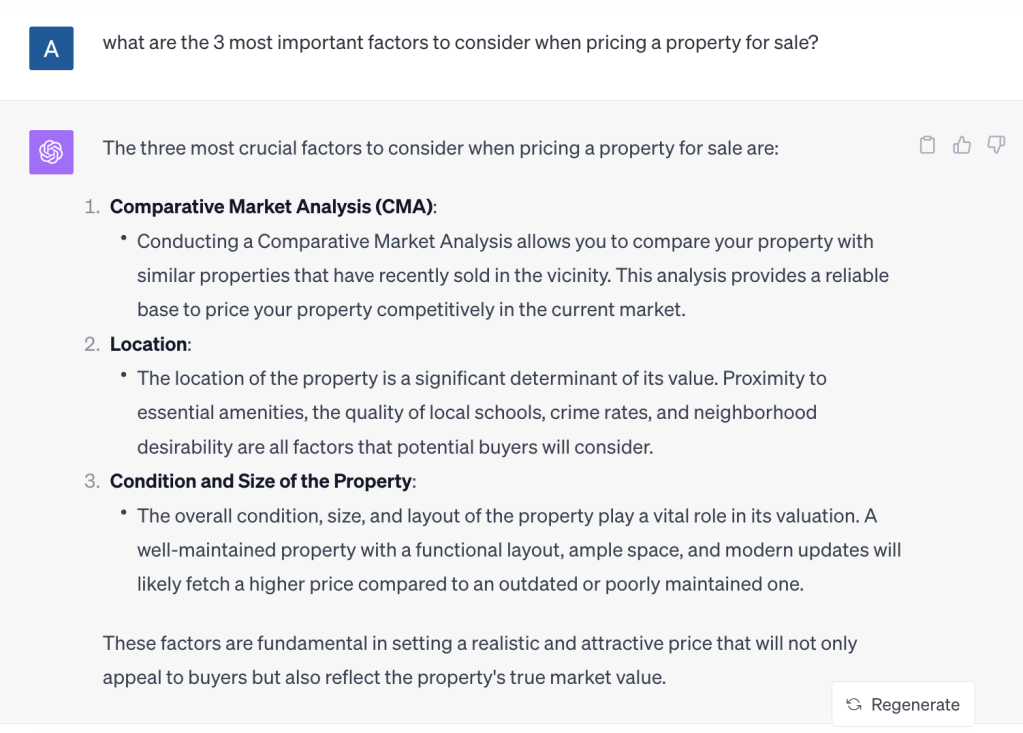
Frame questions in an open-ended manner to encourage more detailed and informative responses. For instance, ask, “What are the most important factors to consider when pricing a property for sale?” You could ask a yes-or-no question, but what good is that? Get as much substance and detail as you can. As an example, here’s ChatGPT’s reply to my query about home pricing:
Break down complex questions.
If you have a multi-part question, consider breaking it down into multiple simpler questions. This can result in more accurate and comprehensive responses. ChatGPT has a handy copy function (look for the little clipboard icon) that allows you to quickly and easily copy the results into a document for later organization.
Include context
When relevant, provide context to help ChatGPT understand the subject or background of your question. For example, “In the current seller’s market, what strategies can buyers use to negotiate better deals?”
Specify data and sources.
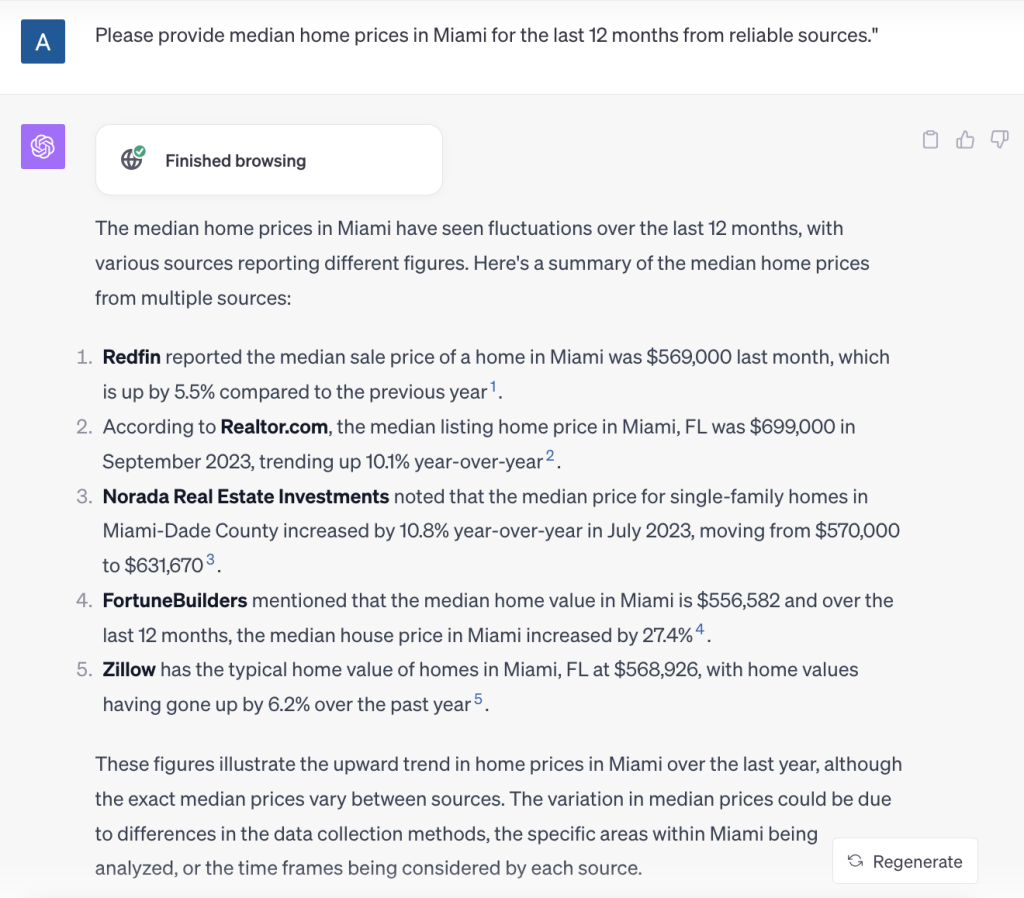
If you need data or information from a specific source, indicate it in the prompt. For instance, “Please provide median home prices in Miami for the last 12 months from reliable sources.” And if you forget to be so specific in your initial prompt, don’t hesitate to ask ChatGPT to refine the response. As an example, here’s ChatGPT’s reply to my query about Miami:
Test and iterate
Start with simple prompts and refine them as you gain a better understanding of how ChatGPT responds. Experiment and test different phrasings and structures to see which yields the best results. As I said before, you can’t break anything.
Request step-by-step guidance
If you want ChatGPT to help with a process, ask for step-by-step instructions. For instance, “Can you guide me through the process of creating a comparative market analysis for a property?”
Ensure that the information provided in responses aligns with your knowledge and real estate standards. ChatGPT may give a response based on the rules and practices of one state, but your state operates differently. Cross-reference with trusted sources when necessary.
Avoid leading questions
Try to keep your questions neutral and avoid leading questions that might inadvertently bias the responses. You may have specific religious or political beliefs, or even just opinions about the housing market, but try to keep those out of your prompts. You want to ensure that the output is relevant and applicable to all clients.
The full picture: ChatGPT for real estate
These are not hard-and-fast rules. There is no wrong way to use ChatGPT. These recommendations will save you some legwork and hopefully generate useful responses for your business. By following these guidelines, you’ll enhance the quality and relevance of responses from ChatGPT and make it a valuable tool for your real estate needs.
These prompts are just the tip of the iceberg. I’ve covered a range of topics to help you utilize ChatGPT in your business, but feel free to explore and experiment further. You can’t break anything, and ChatGPT won’t get mad at you.
Real estate advice + top tech, lead gen & marketing tools — delivered to your inbox.
Get expert advice, independent reviews and product recommendations from our editorial team of experienced real estate agents, brokers and coaches.
https://www.juliankent.com/wp-content/uploads/2025/11/logo.png00JKentshttps://www.juliankent.com/wp-content/uploads/2025/11/logo.pngJKents2025-06-10 00:02:052025-06-10 00:02:0511 clever ways to use ChatGPT for real estate in 2025 (+ prompts)
Discussions about the impact of artificial intelligence (AI) have dominated conversations on stage at HousingWire‘sThe Gathering. But there seems to be little common ground as some lenders are excited for the chance to scale their businesses to new heights by taking away menial tasks, while others are concerned about information security and job insecurity.
Jason Bressler, chief technology officer for United Wholesale Mortgage (UWM), is trying to change the narrative around AI being integrated into the mortgage industry and lending solutions.
In a session dubbed “The CTO Playbook,” Bressler told audience members that he considers the use of AI as a form of “empowerment” and “protection.”
“What we need to understand is that AI is not some experience at the end of the day … it is a predictive analyst,” he said. “But everything, as you look at that, boils down to one thing: data. It’s all about the data, and having reliable data and confident data, in what we’re doing and the decisions that you’re making possible.”
To AI naysayers, Bressler warned that resisting the integration of AI chatbots and solutions is akin to 1990s mortgage companies that resisted the internet. This could lead some companies to fall behind. The same root Bressler alluded to is technological intimidation.
“You don’t need to come up with a giant strategy. AI does not have to be expensive. … There is always a way to improve or change the manufacturing process. It could be operationally, it could be getting leads,” he said. “Remember, AI doesn’t have an NMLS. It can’t do everything.”
As the CTO for the largest mortgage company in the U.S., Bressler discussed toeing the line of developing in-house technology — what he refers to as a build versus buy mentality — and keeping that technology from replacing any of UWM’s several thousand employees. The company claims it has never had to lay off any team members.
“Technology should work to enhance the job that you do, that loan officers do, that real estate agents do. It should never replace everyone. It should take away the tedious, laborious tasks,” he said.
Bressler’s example was UWM’s AI-powered loan assistant, MIA, which makes outbound calls, asks and answers questions, takes messages, collects callback info, and even follows up with borrowers for refinance opportunities.
“There are a lot of us here who understand AI. There are a lot of us who have taken all kinds of risks and failures in using it, and have done all kinds of things,” Bressler said to the audience. “At the end of the day, utilizing AI helps our industry because it levels our playing field.”
https://www.juliankent.com/wp-content/uploads/2025/11/logo.png00JKentshttps://www.juliankent.com/wp-content/uploads/2025/11/logo.pngJKents2025-06-10 00:02:042025-06-10 00:02:04UWM’s Jason Bressler challenges the fear-driven narrative around AI in mortgage lending
Glenn Kelman’s wife was starting to get worried. The Redfin founder and CEO’s behavior was unusual lately. He was staying up late into the night exchanging texts with someone.
But there was no other woman. Kelman was group texting Varun Krishna, the CEO of Rocket Companies, and Jay Bray, the CEO of Mr. Cooper. They would share their unified vision for transforming the homeownership journey and — importantly — making it more affordable for consumers.
For the first time since the news of the acquisitions were announced, the three CEOs sat down with HousingWire‘s Clayton Collins to talk about how and why the deals went down.
How the deals happened
Krishna, a product guru who previously worked at Paypal and Intuit, is a diehard fan of Redfin. He uses it every day — and it’s really his fandom that led to the acquisition.
In fact, he talked about what Redfin could do at Rocket during his interview process. He and Kelman began chatting, they met in Seattle and “one thing led to another,” Krishna told Collins.
With Mr. Cooper, he met with leaders across the industry over the first eight weeks of his tenure at Rocket. Bray took him under his wing, shared with him the nuances of the servicing business and the value of lifetime relationships. “It was love at first sight,” Bray said.
Krishna said it felt that the trio had a shared vision and a “moral responsibility” to champion and create a better housing market for consumers.
“It’s a chance to redfine homebuying in the consumer’s favor,” Kelman added. “We’ve been at it for a long time. … People under 40 don’t believe they have a shot at owning a home. That seems like a fundamental revolution in the American mindset, and I want to spend my professional life working to make that better.”
Room for more
Krishna told Collins that Rocket’s thesis is rather simple at its core.
It has a theory for how well the sales funnel works, attaching experiences like mortgage, converting leads and demonstrating efficacy throughout the mortgage process. That’s followed by “delighting” homeowners in servicing. They’re focused on a “kick-ass consumer experience” to grow their share of profitability.
Krishna also said that Rocket is focused on building an ecosystem that other companies in the housing space could join.
He identified three specific value propositions to the consumer: low costs and low fees; easy and fast; and certainty and confidence that the deal will close. If they can deliver on all three, they’ll have customers for life, he said.
Thoughtful branding
Kelman said that their slavish devotion to the best customer experience means they’ll be distributing leads to the best agent for that consumer, even if it comes at the expense of a Redfin agent getting the deal done.
Kelman added that its Bay Equity mortgage business (a retail lender) will remain in play, and he expressed admiration for Rocket’s efficiencies in originating loans.
The branding integration of Mr. Cooper will be done “thoughtfully,” Krishna said. The company, formerly known as Nationstar, is America’s largest mortgage servicer and is expected to be rebranded to Rocket (another top-five servicer) over time.
But Redfin will remain Redfin. Krishna told Collins that it’s an incredibly important brand. “Millions of consumers will continue to love and appreciate the Redfin brand,” he said.
Rocket already did a large brand reunification, renaming its Amrock title company as Rocket Close.
Mr. Cooper business channels
Asked what’s changed on the client side since the announcement of the deal, Bray told the audience that, essentially, it was business as usual.
“The correspondent relationships we’ve built are very deep; they’re excited about what the combined company can do,” he said, adding that brokers feel the same way.
“We want to grow that channel. I think we have a massive opportunity there.”
Bray said the company can use the power of internal data and share it with broker partners so they can capture the refi.
“Our subservicing business, that community is excited as well,” he said, adding that Mr. Cooper has one large distributed retail partner that has done important work to help with customer retention. “We’re sharing data and retention tools with them. We look at this as a partnership. We want to be a solution for the industry.”
New future of openness
Bray, who will be head of mortgage at Rocket Companies if and when the deal closes, said Mr. Cooper didn’t consider partnering with any other company. It’s grown inorganically through portfolio and company acquisitions.
“With Rocket, I’m reenergized. … Combine the three of us and I think it’s super exciting.”
Kelman expressed similar sentiments.
“What Rocket has done is what I wanted to do. It’s not the enemy. … It’s what we always wanted to become.”
Krishna closed the conversation by saying that Rocket could have been “a better partner” in the past to some in the industry. But this is the start of a different era where “we want to be an enabler,” he added, describing the industry as very “adversarial.”
“I think we can fix that. We want this to symbolize an opportunity to grow business with better tools and tech. We’d love to hear from you.” He asked the audience to email him with their feedback. Just don’t text him late at night.
https://www.juliankent.com/wp-content/uploads/2025/11/logo.png00JKentshttps://www.juliankent.com/wp-content/uploads/2025/11/logo.pngJKents2025-06-10 00:02:042025-06-10 00:02:04‘It was love at first sight!’ Inside Rocket’s pursuit of Redfin, Mr. Cooper
Despite a raft of what might seem like contradictory economic data points and a challenged housing market, the reverse mortgage industry largely proceeded as normal based on key performance metrics for May 2025.
Home Equity Conversion Mortgage (HECM) endorsements dropped by 1% in May to 2,296 loans, despite recent increases in the expected interest rate alongside solid performance from some key lenders.
Meanwhile, HECM-backed Securities (HMBS) issuance saw a modest increase of $9 million month over month despite remaining in historically low territory.
When asked about why business has remained so stable, RMI President John Lunde said that while originators can offer their own thoughts, his own sense is that it’s tied to the nature of where the broader market and economy have been for a while.
“My hypothesis is that we’re basically at a place where home values have gone up so much that even with interest rates restricting the principal limits these past few months, this is still a compelling option for the core HECM borrower profile,” Lunde said.
“Volume isn’t higher because we’ve lost the vast majority of refis, and the upfront cost versus available principal limit is a much harder sell at these levels for potential borrowers that are more strategic and planning oriented.”
Another encouraging sign for the business at large is the fact that retail reverse mortgage origination has a new player that is well versed in the nature of the specific business and is now scaling to include a dedicated retail division. GoodLife Home Loans recently announced that it would open its own retail channel after years of a consistent wholesale presence.
When asked if this might factor into the broader business over the coming months, Lunde said that GoodLife is showing signs of momentum that may be bolstered by a more prominent retail presence.
“I’m looking forward to seeing them perform on the retail side after a long track record on the direct and wholesale sides,” Lunde said. “They’ve risen above Liberty Reverse Mortgage on this report, so this could help them keep that upward momentum, although they have a ways to go before challenging Longbridge Financial for the No. 3 spot.”
When asked about historic data — specifically about how 2025 is coming together in comparison to other recent post-pandemic years — Lunde was bullish, with an asterisk of sorts.
“[2025 is going] better than expected if we had known the path of interest rates heading into the year,” he explained. “It does feel a lot like a ‘new normal’ equilibrium post-pandemic, so we would do best to ignore interest rates as much as possible given they’re out of our control.”
Echoing sentiments shared by other industry leaders recently, the name of the game in the months and years ahead is the business’s distribution profile.
“Expanding distribution remains the key to growing volume and a more controllable source of business for the industry than hoping for interest rates to cooperate,” he said. “I think we’re seeing the benefits of that sustained focus by the more successful companies this year.”
Lunde and RMI speak regularly with industry participants at multiple levels, and those conversations are largely coming with an acknowledgement of current market challenges, he said.
“I’m hearing a lot of similar sentiments where rates are really constraining loan volume, but the secondary market is providing good support to revenue,” he explained. “If rates surprise by dropping a bit, I’m sure that would be a welcome tailwind.”
HMBS issuance: steady at historic lows
Regarding the secondary market, New View Advisors partner Joe Kelly stated that the business is remaining steady while still operating at historic lows in comparison to recent years.
“Yes, it is holding steady at a low level,” he said. “We reiterate our guidance of no material increase in HECM/HMBS origination volume without a significant reduction in the Initial Mortgage Insurance Premium (IMIP).”
That stability extends to the HMBS issuer league rankings, which has consistently featured Finance of America at the top of the list for quite a while. New View “see[s] no reason for the rankings to change materially without any new entrants (or exits),” Kelly said.
But one potential hiccup on the secondary side is the general lack of action on HMBS 2.0, the complementary Ginnie Mae reverse mortgage securities program that saw a fast-tracked development cycle during the Biden administration. The plan has not had any public progress since last November.
“We advise [industry participants] to prepare for a delay in HMBS 2.0 implementation, which means continue to seek buyout and other special financing,” Kelly said.
Despite the steadiness and other market realities, New View largely expects HMBS issuance to land in the same territory that was seen at the end of 2024.
Last year, HMBS issuance totaled $3.95 billion, which was described in January by New View as “the lowest HMBS issuance year since the program’s infancy in 2008” after subtracting tail issuance.
Still, reverse mortgage professionals should “be prepared for the unexpected, including higher interest rates and HMBS 2.0 postponement,” Kelly said.
https://www.juliankent.com/wp-content/uploads/2025/11/logo.png00JKentshttps://www.juliankent.com/wp-content/uploads/2025/11/logo.pngJKents2025-06-10 00:02:042025-06-10 00:02:04Reverse mortgage performance was largely steady in May
Canadian-based RARE Real Estate has launched operations in South Florida, marking its official entry into the U.S. market.
The move is part of a broader expansion strategy by the fast-growing brokerage, which gained recent attention through its feature on the Amazon reality series “Luxe Listings Toronto.”
RARE’s entry into the U.S. market is led by company founder Adam Stern, who has more than 20 years of experience in the real estate industry. He has overseen more than $12 billion in sales and trained more than 4,000 agents across 16 offices.
“We’re thrilled to bring RARE to South Florida because the future of the brokerage business belongs to bold, entrepreneurial agents,” Stern said. “For years, the top 10% of agents have dominated the industry, yet traditional brokerages have failed to truly reward them in a real way.
“The old promises — training, support, mentorship and guidance — haven’t changed in decades. It’s time for a model that puts up-and-coming agents and top producers first, creating real financial incentives for the agents driving this industry forward.”
Founded by Stern and Ryan Rabinovich, RARE Real Estate has recorded more than $4.5 billion in sales in less than four years. It positions itself as an alternative to traditional brokerages by offering what it calls a business-partner model — promising more direct financial rewards and operational freedom for agents.
Office partner Brett Starke, who was also featured on “Luxe Listings Toronto,” credits the company for enabling his own growth.
“When I joined RARE, I led a team of three. Today, I run my own office with 55 agents,” he said. “The RARE model is designed to unlock potential — it gave me the freedom, support, and infrastructure to build something real and lead on my own terms.”
While South Florida is the company’s first U.S. foothold, leadership said it’s actively assessing expansion targets.
https://www.juliankent.com/wp-content/uploads/2025/11/logo.png00JKentshttps://www.juliankent.com/wp-content/uploads/2025/11/logo.pngJKents2025-06-10 00:02:042025-06-10 00:02:04RARE, a Canadian brokerage featured on reality TV, enters the US market
A California real estate broker is suing the National Association of Realtors (NAR) over a policy that forces brokers to pay dues for agents who aren’t members of their state, local or national Realtor associations.
John Diaz, who’s based in Modesto, claims that NAR’s Variable Dues Formula (VDF) policy penalizes brokers for associating with agents who aren’t Realtors. He claims this limits a broker’s ability to compete with larger firms by imposing undue financial pressure that disproportionately impacts small brokerages.
In the charges, Diaz claims that the policy is “an illegal group boycott” that has “no legitimate justification.” He said the result of the policy is “reduced consumer choice, artificial inflation of business costs and market foreclosure for alternative business models in real estate brokerage.”
The California Association of Realtors (CAR), the Lodi Association of Realtors and the Central Valley Association of Realtors are also named defendants in the suit, as are five unknown “Does” whom Diaz said he will name when their identities are uncovered.
CAR declined to comment to HousingWire. The other defendants and representatives for Diaz could not be reached immediately.
The lawsuit states that many agents choose not to become Realtors in remote areas like Modesto, where the trade group doesn’t provide benefits. But not being a Realtor can prevent a brokerage from hiring them because of the financial barrier it poses.
The case is being brought “per se,” meaning that the plaintiff claims that the behavior is inherently illegal and anticompetitive, thus absolving them of proving any negative impact of the rule.
The plaintiff charges the defendants with violations of the Sherman Act and the California Cartwright Act.
The VDF rule is written into NAR’s bylaws and requires brokers to pay additional dues for each non-Realtor agent working for the brokerage. Failure to do so can result in the broker’s own membership being suspended or revoked.
But Diaz said there are “legitimate and lawful business interests” in hiring licensed agents for tasks that don’t require NAR membership or services related to membership.
Examples provided are “Agent Visual Inspection Disclosures” — which are required by California state law — commercial sales and leasing activity. Diaz believes the VDF rule punishes brokers for hiring personnel to perform these duties.
Diaz’s suit is the latest in a long line of attacks against NAR policies and rules, most notably the landmark Sitzer-Burnett case that NAR settled for $418 million. The plaintiffs in the case asserted that NAR’s requirement for listing agents to provide blanket offers of compensation to buyer agents on NAR-affiliated MLSs was anticompetitive.
The settlement roiled the industry and imposed new rules that ban offers of agent compensation on the local MLS, in addition to requirements related to the agreements that prospective homebuyers sign with their Realtors.
Sitzer-Burnett was also brought per se, and the Missouri judge in the case — Stephen Bough — allowed it to proceed as such. Industry observers believe that played a huge role in NAR losing the case.
https://www.juliankent.com/wp-content/uploads/2025/11/logo.png00JKentshttps://www.juliankent.com/wp-content/uploads/2025/11/logo.pngJKents2025-06-10 00:02:042025-06-10 00:02:04‘No legitimate justification’: California broker sues NAR over ‘anticompetitive’ dues
Studio Doherty transformed a former Hawthorn church into a house. Picture: Derek Swalwell.
Transforming a former house of worship into a home can be challenging but the outcome spectacular.
Melbourne-based Studio Doherty director Mardi Doherty spent about 18 months on a project to restore and convert a 1910s Hawthorn church for her clients, a family of five.
And they’re not the only ones as the converting religious hubs into homes has been growing in popularity as an increasing number of churches hit the market across Victoria.
Ms Doherty said that a previous residential conversion, dating to the late 1990s or early 2000s, had left the space feeling “dark, overly partitioned and lacked sensitivity to the building’s original spirit”.
“There was a heritage overlay on the exterior of the building, so we approached the project with a strong focus on retention and respect,” she said.
“Key heritage elements like the timber trusses, parquetry flooring and original stained-glass windows were preserved and celebrated.”
Ms Doherty said that her clients were deeply engaged in the design process and had an appreciation for the building’s original character.
“They added some of their own layers too, like introducing personal religious artefacts, including a decorative crucifix in the outdoor bathroom that they had found and repurposed,” she said.
The clients wanted to maintain the former church’s character. Picture: Derek Swalwell.
The kitchen looks like it could be from a modern, stylish house … Picture: Derek Swalwell.
… but most homes don’t have detailed stained glass windows depicting religious stories and figures. Picture: Derek Swalwell.
A particularly special moment in the design process was the creation of an outdoor bath, located in a second-floor courtyard just off the main bedroom.
“The client had always loved the idea of bathing outdoors, but with a sense of enclosure and privacy,” Ms Doherty said.
“From this space, you can look up to the sky and across to the stained-glass windows and glass void below.”
Studio Doherty director Mardi Doherty. Picture: Sean Fennessy.
The outdoor bath and a decorative crucifix. Picture: Derek Swalwell.
The material palette sued was kept soft and textural to balance the vibrancy of the stained glass windows. Picture: Derek Swalwell.
However, lighting the three-storey interior stairwell proved a complex feat.
“We commissioned a custom chandelier by Christopher Boots, designed to work with the scale of the space and complement the stained-glass windows,” Ms Doherty said.
“Installing it was no small task – it required full scaffolding, a careful choreography of hands, and a lot of patience to safely suspend the fitting across the full height of the void.”
A sense of history remains in the house. Picture: Derek Swalwell.
There’s also plenty of room to work from home. Picture: Derek Swalwell.
An important tip for house hunters keen to renovate a church is to keep thermal performance top of mind.
“Churches aren’t built for modern standards of insulation, so you’ll need to plan carefully around heating, cooling, and glazing,” Ms Doherty said.
“But if you’re drawn to buildings with history and soul, there’s something really powerful about repurposing a structure with a previous life.
“It requires sensitivity – but the results can be incredibly special.”
Sign up to the Herald Sun Weekly Real Estate Update. Click here to get the latest Victorian property market news delivered direct to your inbox.
https://www.juliankent.com/wp-content/uploads/2025/11/logo.png00JKentshttps://www.juliankent.com/wp-content/uploads/2025/11/logo.pngJKents2025-06-10 00:02:042025-06-10 00:02:04Hawthorn: 115-year-old church transformed into a family home
The mass spread across the entire backyard and began blocking the sun for everyone around it.
A five-month backyard battle has ended for a pair of shocked Aussie first home buyers, but the uneasy peace in their new neighbourhood has a hidden twist that has some on edge.
The couple cautiously bought their first home in about nine months ago, wary of it having an “absolute monstrosity” in the backyard – towering more than 20m and some “as thick as my leg”, but felt they could handle it. Now five months later, an uneasy peace is in place as they watch for fresh shoots.
The “absolute monstrosity” in this case is bamboo out in their new backyard which had overrun not just their entire backyard, but had put neighbours off-side – blocking sunlight from nearby houses with its leaves also littering gutters and backyards all around it.
Some observers said there was so much bamboo he could “build a bridge or skyscraper with it. A couple of knots with string and you could make a 6 storey building”.
The new homeowner said they assessed the situation before purchase and found it was a clumping, not running, type of bamboo – which means they had a shot at removal, taking a massive 22 weeks to rid the neighbourhood of it.
“Well after about a day a week since Christmas we finally cut the last piece down,” the homeowner said. “Some were 20m + and as thick as my leg. Now to find an excavator to dig it all up.”
“+1 to having awesome neighbours who let us take down the fence and have full side access via their property the whole time,” the homeowner said. “Wouldn’t have been able to do it without that so we are very grateful. Although they are just as stoked it’s gone themselves.”
But that’s not going to last long, others warned, saying removing the top is the easy part over for the couple – with much more vigilance and brutality required to make sure it’s not going to be causing more damage in future.
One day a week since Christmas the first home buyers have been hacking away at this.
One who had the same thing around horse stables, said the rhizomes were a nightmare to remove: “ohhh my heavens!!!! Could you get a smallish bulldozer in, to lift what’s left, out of the ground?? I really want you to win this war, cause that’s what it is!”.
Another warned: “Don’t look now, but there are probably 20 shoots coming up amongst all that. In two weeks, they’ll be a metre tall or coming up in your neighbour’s yard. Ask me how I know”.
Among the advice dished out was that “unless you get weed killer on the cut within about 10 seconds, the wound has self-sealed and the herbicide is useless”.
The homeowner was very aware of the challenge to come though: “yeah saw that online so we pretty much sprayed each shoot the second we cut it. Seemed to work quite well. Within a week they’d lost all colour and gone hard. If we missed one it was back in days.”
The challenge is so overwhelming for some homeowners that they’ve even sold up and moved elsewhere bamboo-free: “I had a big clump of bamboo something like that at a house I once owned. Took about six months of hard yakka cutting it, digging out roots with a pick axe etc. Got to the point where I had it not quite totally eliminated, but well controlled, then I sold and bought elsewhere.”
Neighbours let them take down a fence in order to have ease of access for equipment and rubbish removal.
An arborist chimed in saying “we cut down / kill bamboo clumps and other hard to kill plants almost every day. It definitely works just takes a few months with some species of bamboo. There are other chemicals that are more effective but you don’t want that — the good thing about roundup is it’s only just strong enough to kill things. You don’t want to salt the earth — presumably one day you’ll plant something else there. Roundup will allow that.”
Digging up the mass underground had three solutions the arborist said: cut the stump/roots away with a mattock once it’s dried, wait longer then use a shovel or hire a stump grinder if you want it gone quick.
“Just beware if you hit a rock or metal, the stump grinder could have to be repaired. That’s the main reason stump grinding companies are so expensive. If you hire a grinder and DIY the job, they’ll check for damage and the bill will be really high if you’ve hit anything.”
Landscape designers pay a lot for mature clumping bamboo.
Others have suggested just brutalising it with an excavator instead: “I had some in my backyard but most were only 15-30mm thick. After cutting them down to ground level I used a 1.7t excavator with teeth on the bucket and it did alright. Would probably recommend a 2.7t if you have the access and use a ripper. Do all the hard work sitting down.”
Not everyone agreed with the homeowner’s choice to tear it down, with one playing devil’s advocate to say “landscape designers pay big dollars for mature specimens like that. Clumping bamboo is the best type of bamboo you can have”.
“They need to be pruned and maintained so people don’t become overwhelmed and insecure. Now you’ve lost all that wonderful shade and windbreak. Oh well. It’s your property. It’s your Castle. You can do what you want. I just thought I’d put it out there for the bamboo lovers who are probably in tears.”
The Ghost Bamboo (clumping variety) which featured in designer John Middleton’s exhibit at the Melbourne International Flower and Garden Show.
Those bamboo lovers agreed it looked better before it was cut down, saying it “makes the most serene sounds in the wind”, “we have two sides very happily privatised with clumping Nepalese Blue” and “it looked good… now it looks sh*t”.
The homeowner stuck to his guns though, saying “the whole neighbourhood was sick of the leaves going everywhere and filling everyone’s gutters. It killed everything around it. And our house is now full of natural light. It won’t be getting left as it currently is. nice fence, Tropical garden and a pool going in.”
GUIDE FOR AUSSIE HOMEOWNERS
What not to plant
Bamboo
Golden cane palm
Gum tree (large species)
Common fig
Lilly pilly (large species)
Umbrella tree (an environmental weed in this area)
West African tulip (this a Class 3 weed)
Pine tree
Poinciana
Jacaranda
Broad – leafed paperbark
Weeping paperbark
Mango tree
Coral tree
Willow (all types) (this a Class 3 weed)
Camphor Laurel (this a Class 3 weed)
Wisteria
Black bean
What to plant
Directly above or up to 1.5m away from water supply and wastewater pipes
Blue flax lily
Tall sedge
Spiny-headed mat-rush
Common tussock grass
Kangaroo grass
Common hovea
Between 1.5m and 3m away from water supply and wastewater pipes
Austral indigo
Dogwood
Dwarf banksia
Hairy bush pea
Sweet wattle
Woombye bush
Broad – leaved palm lily
More than 3m away from water supply and wastewater pipes
We may request cookies to be set on your device. We use cookies to let us know when you visit our websites, how you interact with us, to enrich your user experience, and to customize your relationship with our website.
Click on the different category headings to find out more. You can also change some of your preferences. Note that blocking some types of cookies may impact your experience on our websites and the services we are able to offer.
Essential Website Cookies
These cookies are strictly necessary to provide you with services available through our website and to use some of its features.
Because these cookies are strictly necessary to deliver the website, refusing them will have impact how our site functions. You always can block or delete cookies by changing your browser settings and force blocking all cookies on this website. But this will always prompt you to accept/refuse cookies when revisiting our site.
We fully respect if you want to refuse cookies but to avoid asking you again and again kindly allow us to store a cookie for that. You are free to opt out any time or opt in for other cookies to get a better experience. If you refuse cookies we will remove all set cookies in our domain.
We provide you with a list of stored cookies on your computer in our domain so you can check what we stored. Due to security reasons we are not able to show or modify cookies from other domains. You can check these in your browser security settings.
Other external services
We also use different external services like Google Webfonts, Google Maps, and external Video providers. Since these providers may collect personal data like your IP address we allow you to block them here. Please be aware that this might heavily reduce the functionality and appearance of our site. Changes will take effect once you reload the page.
Google Webfont Settings:
Google Map Settings:
Google reCaptcha Settings:
Vimeo and Youtube video embeds:
Privacy Policy
You can read about our cookies and privacy settings in detail on our Privacy Policy Page.




 Follow the steps in the workflow before using the prompt for the best results (click the arrow to expand the text).
 1. Identify your audience
 2. Choose your cadence and duration
 3. List their pain points
 4. Teach ChatGPT how to write like you (or anyone)
 5. Write your prompt (or use our prompt below)
 6. Ask ChatGPT to refine your prompt
 7. Edit the results





 JKDS is a licensed New York State real estate brokerage firm. #10351200205