

Put effort into the before, during and after of the listing appointment to position the property and generate additional leads from the process, Nick Schlekeway writes.
The 2025 New York City mayoral election will have huge impacts on housing in the city, including where it gets built and how to make it affordable for everyday New Yorkers.
In just two weeks, registered voters will rank their choices for mayor in the Democratic primary election on June 24th (early voting begins June 14th). As that pivotal date approaches, renters and owners alike have a chance to evaluate which candidate’s housing plan best serves the city.
All the candidates want to accelerate the speed of housing production in NYC, to build thousands—even hundreds of thousands—more apartments than the less than 30,000 housing units NYC developers built in 2023. But how they intend to build these apartments differs widely between the mayoral hopefuls.
Read on for an overview of the housing plans for all of the nine major Democratic candidates for mayor.
[Editor’s note: The candidates included in this article are those running in the Democratic primary. They are listed in alphabetical order by last name. This list does not include two independent candidates—current Mayor Eric Adams and attorney Jim Walden—and Republican candidate Curtis Sliwa, who are not a part of the Democratic primary.]

Caption
Council speaker Adrienne Adams entered the mayor’s race in May.
Credit
Photo courtesy John McCarten/NYC Council Media Unit
Adrienne Adams
Council speaker Adrienne Adams has touted her record in the City Council in the mayor’s race. As speaker, she helped pass the City of Yes for Housing Opportunity, a landmark series of zoning reforms that will pave the way for 80,000 new housing units over the next 15 years. She told the New York City Housing Conference that she plans to use the City of Yes to build more affordable housing throughout NYC.
As mayor, she says she will expand eligibility for the CityFHEPS housing voucher program—something the City Council passed in 2023, but Mayor Adams stonewalled. She also intends to dedicate more city funding to fix dilapidated New York City Housing Authority units, incentivize repairs at rent-stabilized apartments, and increase staffing at the city’s housing agencies.

Caption
Michael Blake previously served as a New York Assemblyman and vice chair of the Democratic National Committee.
Credit
Photo courtesy Joe Mabel/Wikimedia Commons
Michael Blake
Michael Blake, a former New York State Assembly member and perennial candidate, wants to change how NYC determines who qualifies for affordable housing.
Currently, eligibility is determined by the area median income—the median income for households of different sizes. That metric is based on income data for the five boroughs, plus Putnam, Rockland, and Westchester counties, which doesn’t represent the true cost of living for city-dwellers, Blake said. He wants to determine a local median income that would replace AMI in affordable housing applications.
Blake also wants to build more Mitchell-Lama housing, eliminate credit checks for rental and mortgage applications, work with the state government to reform NYC’s property tax system, and said he would tax pieds-à-terre to help fund upgrades at NYCHA.

Caption
Former Governor Andrew Cuomo will run on an independent ballot line regardless of whether he wins the June 24th Democratic primary, according to CBS.
Credit
Photo courtesy Marc A. Hermann/MTA NYC Transit/Wikimedia Commons
Andrew Cuomo
Former Governor Andrew Cuomo’s housing plan includes increasing city and state subsidies for affordable housing, using NYC’s pension funds to invest in new housing developments, and supporting office to residential conversion projects.
He also wants to study why landlords may be keeping rent-stabilized apartments vacant—a practice known as warehousing—and develop a subsidy program to renovate vacant units. But during the mayoral debate on Thursday, June 13th, he declined to commit to a rent freeze, and instead said he’d leave it up to the Rent Guidelines Board, the panel of mayoral appointees that sets rents for rent-stabilized apartments.
Cuomo’s housing plan got a lot of attention when it was released in April, though probably not for the reason his team had hoped: The Cuomo campaign caught significant flak for using ChatGPT to provide research for the candidate’s housing plan, as well as the inclusion of a number of spelling and grammatical errors.

Caption
Brad Lander announced a plan in March to build housing on some of the city’s municipal golf courses.
Credit
Photo courtesy Lander for Mayor
Brad Lander
Former NYC Comptroller Brad Lander plans to declare the housing crisis in NYC an emergency, allowing him to fast track his plan of building 500,000 new housing units over the next 10 years. (That includes a plan to build housing on four of the city’s 12 municipal golf courses.)
He also wants to use city funds to purchase and rehabilitate distressed buildings, help city workers buy property through co-ownership with the city, and make co-living legal in NYC. For NYCHA residents, Lander plans to create a system for tenants to review and score contractors that repair—or fail to fix up—their apartments.
He also called in April for a one-year rent freeze for the city’s rent-stabilized apartments, though he initially told Brick Underground that he’d support a rent freeze based on data presented to the Rent Guidelines Board.

Caption
Alexandria Ocasio-Cortez endorsed Zohran Mamdani as her first choice in a ranked choice ballot in June, followed by Adrienne Adams, Brad Lander, former Comptroller Scott Stringer, and State Senator Zellnor Myrie.
Credit
Photo courtesy Kara McCurdy
Zohran Mamdani
State Assembly member Zohran Mamdani of Queens was the first mayoral candidate to call for a rent freeze for the city’s rent-stabilized apartments in October, and that promise has been a central part of his campaign.
If elected, Mamdani also plans to have the city directly finance the construction of 200,000 new rent-stabilized apartments, and he told Brick Underground that he would push for the expansion of rent stabilization to all new housing production in the city—something state legislators would have to pass.
Mamdani also announced a plan to bolster the Mayor’s Office to Protect Tenants, and to ramp up code enforcement against negligent landlords by hiring more staff at the city’s housing agencies.

Caption
Zellnor Myrie currently represents central Brooklyn in the New York state senate.
Credit
Photo courtesy NY Senate Photo
Zellnor Myrie
State Senator Zellnor Myrie wants to build around one million housing units over the next decade, through a combination of increasing how densely developers can build, speeding development approvals by hiring more city staffers, and redeveloping public buildings.
Myrie told Brick Underground that close to half of those million units will be affordable for New Yorkers through existing city programs, such as mandatory inclusionary housing, which requires developers to include rent-stabilized apartments in exchange for building denser developments.
Myrie also plans to fully fund and expand NYC’s right to counsel program, which currently gives income-eligible New Yorkers a right to an attorney in housing court. Myrie would give victims of deed theft a right to an attorney as well.

Caption
Jessica Ramos represents parts of Queens in the New York state senate.
Credit
Photo courtesy NY Senate Media Services
Jessica Ramos
State Assembly member Jessica Ramos recently endorsed Andrew Cuomo for mayor, but she has not dropped out of the race, CBS reported.
She has also called for a rent freeze, and her housing policy positions include promoting modular housing in NYC, converting office buildings to housing, and allowing more New Yorkers to qualify for the CityFHEPS housing voucher program, Ramos told the New York Housing Conference.
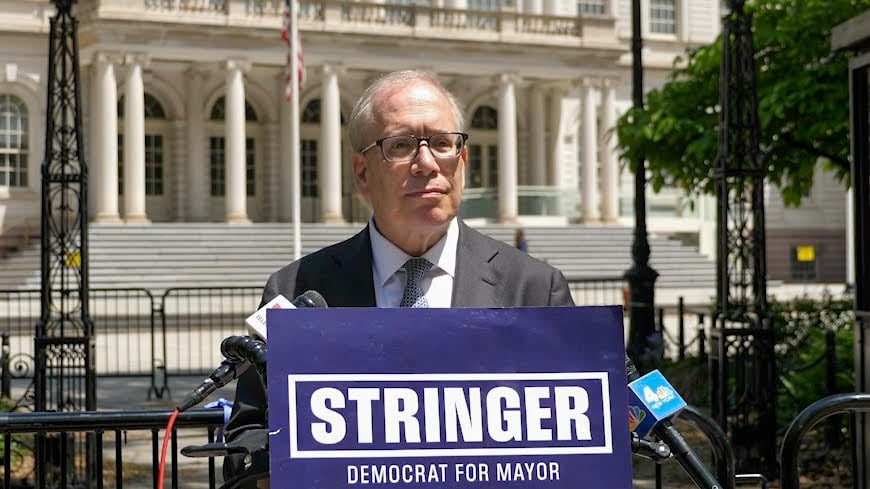
Caption
Scott Stringer has served in the New York state assembly, as Manhattan borough president, and NYC comptroller.
Credit
Photo courtesy Scott Stringer for Mayor
Scott Stringer
Former NYC Comptroller Scott Stringer is running for mayor on a promise to build more Mitchell-Lama housing on city-owned land to create affordable co-op and rental units for New Yorkers.
If elected, he also intends to use eminent domain to seize properties from negligent landlords and transfer them to developers who can build more affordable housing. Those new developments—and others created under his housing plan—will prioritize apartments with two bedrooms or more to accommodate NYC families.

Caption
Whitney Tilson also told Brick Underground that he would not support a rent freeze.
Credit
Photo courtesy Eaglebrook School/Wikimedia Commons
Whitney Tilson
Long-time Democrat and former hedge fund manager Whitney Tilson wants to work with the real estate industry to spur development in NYC.
Tilson told Brick Underground that he would appoint pro-development city staffers to encourage large-scale projects, and that the city should be able to quickly approve developments from good operators. He also said he wanted to make it easier for small landlords to evict non-paying tenants.
|
Would you support a rent freeze for rent-stabilized apartments? |
Would you support rolling back NYC’s short-term rental restrictions…? | Should fines be enforced for buildings not in compliance with Local Law 97? | Would you support expanding eligibility for CityFHEPS…? | |
|---|---|---|---|---|
| Brad Lander |
Yes. |
Yes, to achieve my HomeShare NYC plan. | Yes, but “a better system is needed.” | Yes, if the state passes the Housing Access Voucher Program. [It did.] |
| Zohran Mamdani | Yes. | No. | Yes, but we should make it easier to comply. | Yes. |
| Scott Stringer | Yes, if the data supports it.
|
No. | We should take a look at heavy fines. | Yes. |
| Zellnor Myrie | No. | Yes. | Yes, but we should provide assistance. | Yes. |
| Michael Blake | Yes. | Yes. | Yes. | Yes. |
| Whitney Tilson | No. | No, I would not change the current regulations. | No, fines should be delayed. |
I’m not familiar with that. [In a subsequent text, Tilson said he supports FHEPS.] |
You Might Also Like
Looking for a quick catch-up on the buzziest stories of the week? Here’s Inman Top 5, the most essential stories, according to Inman readers.
California’s Department of Insurance is taking a closer look at how State Farm General Insurance Company handled claims tied to the Eaton and Palisades wildfires. On Thursday, the Department informed Inman that it has launched an investigation into the insurer’s conduct.
No one in the real estate industry has the right to discriminate against or disparage a group of people, LGBTQ+ Real Estate Alliance President Justin “JZ” Ziegler writes.
Real estate affinity groups and inclusion leaders told Inman that by shifting potential liability away from local and state Realtor groups, brokerages will now be expected to rule on certain ethics complaints.
Following the release of the president’s fiscal year 2026 “skinny” budget request — and a look at the White House’s performance expectations for the Home Equity Conversion Mortgage (HECM) program — the U.S. Department of Housing and Urban Development (HUD) has released its congressional justifications document to explain the reasons for its appropriations requests.
Normally, this document provides detail about the HECM program, its performance outlook and anything the Federal Housing Administration (FHA) might seek to change. This year, however, that’s not the case, according to a review of the document by HousingWire’s Reverse Mortgage Daily (RMD).
In regard to administrative contracts for the Mutual Mortgage Insurance (MMI) Fund — which provides cash to lenders on HECM claim payments for assigned loans — the budget requests $160 million to fund a series of loan programs operating under the MMI Fund, including HECM loan servicing tools.
This is a rare instance where the appropriations request is somewhat higher than in years past, HUD explained. A big part of this request is tied to managing the HECM portfolio.
“Funding for administrative contracts has remained constant at $150 million since 2022,” the document reads. “At the same time, contract expenses have increased with inflation and growth in the FHA-held portfolio of HECMs and partial claim notes.
“Between 2014 and 2024, program account expenditures for management of Secretary-held HECMs and partial claims have increased by $46 million, growing from $3.6 million to $49 million, a 1,272% increase.”
The FHA-assigned HECM portfolio has also grown tenfold since 2013, from 18,000 loans to more than 190,000 today.
“The cost of managing the assigned HECM portfolio has grown even faster, from $1.8 million in 2014 to $36.5 million in 2024. Largely as a result of these factors, total available funding decreased from $174 million in 2021 to a projected $160 million in 2025,” HUD explained.
“The Budget request for $10 million above the 2025 level is necessary for FHA to maintain current service levels through 2026.”
Outside of this, only one major mention of the HECM program exists across the 134-page document — a justification for HUD’s commitment authority for new loan guarantees.
“The 2026 President’s Budget requests $400 billion in loan guarantee commitment limitation, which is to remain available until September 30, 2027,” the document states. “This limitation includes sufficient authority for insurance of all single family forward mortgages and HECMs.
“Total loan volume projected for all MMI programs for 2026 is $315.1 billion. Of that total, $300 billion is estimated for standard forward mortgages and $15.1 billion is for HECM.”
This requested figure matches what was requested last year, and the projected HECM performance is consistent with recently released projections from the White House.
But HUD does not indicate any additional focus or intent to reform aspects of the HECM program — a departure from some of the Biden administration’s stated goals one year ago.
At that time, the congressional justifications for FY 2025 included a series of legislative recommendations that required congressional support to implement.
These included housing counseling for HECM-to-HECM refinance transactions, alongside a removal of the cap on the number of HECM loans that can be insured by FHA.
The lack of inclusion of a cap-removal request, in particular, is a departure from years past since it consistently appeared on HUD’s list of HECM proposals for several years. But Congress has yet to agree to any such measure.
HUD in 2024 also sought to update the actuarial analysis used to set mortgage insurance premiums on HECMs. In 2003, the department satisfied a statutory requirement that it would “conduct an actuarial analysis to determine the adequacy of its HECM insurance premiums with respect to lower upfront premiums for refinances and a single national loan limit, and the combined effects of those two policies.”
HUD also said last year that it wanted to change mandated notices of foreclosure within the HECM program to include outreach methods beyond traditional mail. And the department renewed a legislative request to restore regional lending limits to the HECM program, which the industry and its principal trade association have consistently and vehemently opposed.
Mortgage veteran Glenn Stearns is taking a different approach with his latest venture.
Kind Lending, a national wholesale mortgage lender and his second brainchild, is built on lean operations and a focus on efficiency — a contrast with his first company, Stearns Lending, which filed for Chapter 11 bankruptcy in 2019.
“This is not our first rodeo,” Stearns said in an interview with HousingWire.
Private equity giant Blackstone conducted the Stearns Lending bankruptcy process after acquiring a majority stake in parent company Stearns Holdings in 2015. The company was later sold to Rate in 2021, only for its wholesale channel to be shuttered the following year. Meanwhile, Stearns launched Kind in 2020 in the midst of the COVID-19 pandemic.
“When we started Kind Lending, we had margins of 450 basis points, which went to 40 in April 2020,” Stearns said. “We got started in a very hostile environment, so we had to be efficient from the start of our company. We didn’t have the same ability to lean on servicing that everybody had from the last cycle. So we started off with a completely different mindset.”
Stearns said the company’s disciplined cost structure has led to consistent profitability — without considering sales of mortgage servicing rights (MSRs) — which sets it apart from many independent mortgage banks (IMBs) that continue to operate in the red.
He’s not wrong. Inside Mortgage Finance (IMF) reported that Kind Lending originated $7.5 billion in mortgages in 2024, placing it among the lenders with more than $4 billion in annual volume — a segment that turned a profit in the first quarter of 2025, according to the Mortgage Bankers Association (MBA). These lenders recorded an average net production income of $882 per loan (20 basis points).
In contrast, very small lenders — those with less than $400 million in annual production — lost an average of $1,029 per loan in Q1 2025. As a group, IMBs posted a net loss of $28 per loan in the same period.
“If you have a quarterly volume of $100 million, it’s very hard to break a profit right now,” said Marina Walsh, the MBA’s vice president of industry analysis. ”I think cost is a big part of it. … You have the technology costs, fixed costs associated with just keeping the lights on, and those fixed costs are divided over fewer loans.”
When costs rise…
As costs rise across the mortgage industry, lenders like Kind are doubling down on efficiency — without compromising service.
“We feel cost pressures these days. Everybody’s seen inflation in different areas – there’s been a substantial inflation in the cost of the underwriter over the last year again,” said Mike Fontaine, co-president of Plaza Home Mortgage, which originated $6.5 billion in 2024, per IMF.
Labor costs remain one of the biggest cost challenges, given the cyclical nature of the mortgage business. Fontaine noted that while mortgage rates have remained relatively flat, even small fluctuations can rapidly affect volume, and quick surges are particularly hard to manage, since hiring and training take time. As a private company, Plaza does not comment on profitability.
“We try to staff according to our projections, but in the volatile market that we’re in right now, it can be challenging,” Fontaine added. “Part of it is outsourcing. Some pieces are in automation.”
AnnieMac Home Mortgage, a smaller lender that originated $3.1 billion in 2024, according to IMF, has adopted a highly variable cost structure to navigate market volatility. CEO Joe Panebianco said the company set a goal of maintaining 70% of its costs as variable — a high bar that it has reached through a combination of outsourcing and technology.
“We’ve been profitable. But you really need a variable business model,” Panebianco said.
AnnieMac’s segment — midsize lenders that originate $2 billion to $4 billion annually — posted the highest net production income in Q1 2025 at $1,295 per loan on average, or 26.5 bps, per MBA data.
Panebianco said one of the steepest cost increases has come from data providers — especially those tied to credit reports and FICO scores.
“Those costs have jumped dramatically, and it’s not something that’s easy to pass on to borrowers,” he said. To manage those vendor costs, AnnieMac is increasingly pursuing long-term agreements that allow for pricing adjustments if business volumes drop for more than a quarter.
Lenders find new sources of revenue
While expense control has been a survival strategy for many mortgage lenders, growth now hinges on finding new revenue streams beyond the traditional Fannie Mae and Freddie Mac loans.
At Kind Lending, Stearns said nonqualified mortgages (non-QMs) have quickly become a key part of the company’s playbook. Kind originated north of $200 million in non-QM loans last month, representing 18% of its total volume.
For Stearns, it’s about “making sure we can compete with the bread-and-butter” loans and then offering products with higher margins. Since the late 1980s, the market has had these options, from second trustees to subprime loans and now non-QMs, he added.
The push toward higher-margin products is a strategic evolution. “Volume is great, but volume without proper net margin is not,” Panebianco said. He expects non-QM products will account for 10% to 15% of overall mortgage volume in 2025.
Plaza is also tapping into niche markets to diversify its income. In addition to non-QM and home equity loans, renovation loans are playing a growing role.
“We’ve offered renovation loans for years,” Fontaine said, adding that the product performs better in certain geographies but is proving valuable in today’s market.
What a difference servicing makes
Mortgage servicing has played a critical role in supporting lenders’ financial performance, especially as origination margins remain thin and market volatility continues. With valuations for MSRs near historical highs, many lenders have opted to sell these assets to generate immediate income.
“Servicing is still helping lenders,” Walsh said. “Delinquencies are rising, but overall, there’s positive net financial income coming in. If you include servicing, it makes at least a 10 percentage-point difference between being profitable and not profitable.”
Plaza, for example, has reduced its servicing portfolio over the past year. As a third-party originator without a dedicated retention group, it doesn’t compete aggressively for borrower recapture.
“The general feeling is that rates will come down — I’ve been saying that for a year and it hasn’t happened yet,” Fontaine said. “We’ve taken the position that we’re better off monetizing some of our servicing now. The market is very good for sellers, and we’re better off taking the money now since we’re not holding servicing for recapture like a lot of the players out there are.”
Kind Lending has taken a similar approach. Stearns said the company has sold most of its servicing to take advantage of high MSR multiples, focusing instead on origination growth. Kind currently services about 5,000 loans, but Stearns said the company plans to begin retaining more servicing as it approaches a servicing book value of $1.5 billion to $2 billion.
While servicing sales can provide short-term financial relief, it raises questions about long-term borrower retention. Stearns acknowledged the trade-off but said it’s part of a phased strategy.
“That’s step two for us,” he said. “We had to make sure we ran a very smooth machine that could originate well, and now that we’ve hit the $1 billion per month, the next thing in our sights is servicing.”
How to beat the big guys
Kind, Plaza and AnnieMac aren’t among the country’s top mortgage lenders by volume, but they’re competing directly with the industry giants. And it’s only getting tougher.
By the end of 2024, the nation’s 10 largest lenders held 44.5% of market share — up seven percentage points from the prior year. With deep pockets, these players have expanded by slashing prices, compressing margins, and executing headline-grabbing acquisitions like Rocket Companies’ deals to purchase Redfin and Mr. Cooper.
While some lenders are also turning to acquisitions — often buying up smaller, distressed competitors — others are betting on organic growth to stay competitive.
AnnieMac, for example, acquired Unify Home Lending in April 2025 and plans another deal soon. The company aims to reach 1% market share, five times its current level, by building a network of hyperlocal experts, a model that Panebianco calls a contrast with large lenders’ reliance on big data.
“My firm belief is that if you are a local expert — if you know every house that is sold, the architects, the landscapers, the electricians, the plumbers, the HVAC folks — that business is yours to lose,” Panebianco said.
He added that as Rocket joins forces with Redfin, he’s not necessarily concerned about losing ground in local markets. Refinance business is different, but purchases still come down to the quality of the people on the ground, he said.
Plaza’s Fontaine said his firm goes head to head with United Wholesale Mortgage (UWM) and Rocket Pro in the wholesale space. But while those giants operate like “Ford manufacturing,” Fontaine likens Plaza to a shop that can “customize your car” by offering a broader product range and more flexibility — with a caveat.
“You have to be relevant on price, but you don’t always have to be the cheapest, and you’re not going to do well if you’re always the most expensive either,” Fontaine said. “There’s a perception that the two big guys are always the cheapest, and I don’t think that’s always an accurate perception.”
For Stearns, organic growth remains key. “Most of our partners want a second choice; we’ve been slowly becoming that second choice,” he said. “So far, it’s been really easy just to duplicate their experience [of UWM and Rocket Pro].”
Having experienced the Blackstone deal at Stearns Lending, he’s cautious about forced scale through M&A. “You can’t fit two different cultures into one organization — one of them won’t survive,” Stearns said.

Brisbane-based buyer’s agent Jack Freestone said buyers in southeast Queensland were trading backyard space for inner-city lifestyle and choosing apartments over houses.
The gap between the price of houses and units in Queensland is tightening in some suburbs and ballooning in others as buyers are priced out of houses and forced into the unit market.
It comes as apartments topple houses in price growth across multiple regions around the country according to data by Nuestar and Hotspotting.
Brisbane leads the charge, with 76.3 per cent of its apartment markets showing stronger growth than houses over the 12 months to May.

Apartments are becoming the preferred choice for both homeowners and investors.

29 Dukinfield Street, Bowen Hills is for sale via expressions of interest.
“With lifestyle benefits, lower costs, and outstanding locations, apartments are fast becoming the preferred choice for both homeowners and investors,” said Nuestar founder Michael Wilkins.
“Prices per square metre are continuing to rise, and developers are recognising that quality design, premium inclusions, and integrated amenity are increasingly the key to market appeal.”
Exclusive Ray White data revealed the top suburbs with the smallest gaps between houses and units, as well as the suburbs where house prices reigned supreme.

4/100 Champions Crescent, Brookwater is for sale at $1.1m.

402/47 Marine Parade, Redcliffe is on the market at $2,774,000.
In Brisbane, Augustine Heights – Brookwater had the smallest gap with a median house value of $1,022,944 compared to units at $1,009,969 — a $12,975 or 1.27 per cent difference.
Wolffdene (4.16%), Leichhardt (18.96%), Eagle Farm (14.37%) and Wacol (21.59%) rounded out the top 5 suburbs in the city with the smallest difference between house and unit prices.
On the Sunshine Coast, Caloundra West had the smallest gap of $174,407 while on the Gold Coast, Pimpama was the front runner with a gap of just $167,037.
Around the State, Miles in the Western Downs Region, recorded a $6,263 gap between the cost of houses and units.
MORE: Quirky solution to housing crisis
Artist builds Aus first aircrete dome home

2502/5 Enderley Avenue, Surfers Paradise recently sold for $769,500.
On the other end of the scale, Newstead had the biggest price difference in Queensland with house medians sitting at $1.884m, and 71.31 per cent more than units.
New Farm, Ascot, Hamilton and St Lucia all recorded gaps of more than 60 per cent each, while on the Gold Coast, Surfers Paradise, Mermaid Beach and Bundall had huge price differences between houses and units.
On the Sunshine Coast, Buddina, Noosaville and Mooloolaba dominated.

Ray White Group chief economist, Nerida Conisbee. Picture: Supplied
Ray White economist Nerida Conisbee said it was getting harder to buy a house in the inner city with more buyers priced out than ever before.
“If you’ve got $750,000, you can probably buy a unit in most desirable suburbs in Australia, maybe not Sydney, but certainly in all other capital cities,” she said.
“Alternatively, you can also buy a house for that money on the urban fringe, which I think is a trade off that people make.
“So it’s a bit of a trade off. Do I want space? Do I want a big property? Or am I prepared to live in a much smaller home but have the amenities that are available to me in these suburbs that are generally in high demand?”

18 Charles Street, New Farm is on the market via expressions of interest.
Ms Conisbee said that as houses became more expensive, more buyers needed to embrace apartment living.
“It’s much cheaper, in terms of infrastructure, for us to get higher densities but it does require quite a shift in the way we look at housing and I think that’s the growing pains we’re going through at the moment,” she said.
Brisbane-based buyer’s agent Jack Freestone said buyers in southeast Queensland were trading backyard space for inner-city lifestyle, with many opting for townhouses and apartments over houses.

21206/37 Kyabra Street, Newstead is on the market with a price tag of offers over $715,000.
It follows Brisbane’s median house price hitting $998,000 while its median unit was now priced the same as its houses were just three years ago in April, 2022 ($690,000).
“More and more buyers in Brisbane and the Gold Coast are choosing to stay in well- connected inner suburbs, even if it means compromising on the type of property they can afford,” Mr Freestone said.
“Rising prices mean a lot of these people can no longer afford to buy a house close to the city, but instead of buying a cheaper house in the outer suburbs, they’re choosing to purchase townhouses or apartments in the inner ring.”
Mr Freestone said the trend was particularly popular among couples without children and young families who valued access to amenities, transport and schools.

REA Group economist Anne Flaherty
REA Group economist Anne Flaherty said buyers were having to compromise when entering or even upgrading in the property market.
“We’re seeing a lot of different buyers struggling with the massive price rises in Brisbane,” she said.
“Increasingly we are seeing families moving into apartments now where as 20 years ago it was standard to buy a house with a garden if you had a family.
“That mindset is starting to change and it comes back to affordability.”

Famlies are increasingly moving into apartments. This property at 2502/5 Enderley Avenue, Surfers Paradise recently sold for $769,500.
But she pointed out the rising costs of building apartment blocks was also contributing to higher unit median prices.
“We typically think of a house as being more expensive than a unit but what we are seeing is the cost per square metre of building an apartment at a much higher rate than it used to be and much higher than building a house,” she said.
“A lot of the new apartments are premium apartment stock targeting cashed up downsizers looking for a more luxurious apartment.
“It you have a suburb and units are being developed for $900,000 plus, that actually skews the median unit prices in that entire area upward.”
The post Units vs. houses: A tale of two cities appeared first on realestate.com.au.

The home at 8 Karrinyup Pl, Marrara. Picture: Supplied
A sprawling Troppo home overlooking the 18th fairway of the Darwin Golf Club is going under the hammer this month.
The home sits on a 1080 sqm block at 8 Karrinyup Pl, Marrara, with pool, lush landscaping and direct access to the golf course.
Designed by Troppo Architects to make the most of the Top End lifestyle, the house is spread across two levels and features jarrah timber floors, louvres, timber screens, exposed beams, vaulted ceilings and easy flow between the indoors and the multiple outdoor living spaces.
The entry to the home is a truly Troppo affair with the front door opening to a landing sitting between the two levels.

The balcony looks out over Darwin Golf Course. Picture: Supplied

The living areas open to the balcony. Picture: Supplied
RELATED: Darwin buyers need extra 47k to lock down a home
Darwin property surge: Australia’s most affordable capital heats up
Insane cash stars spent on their Aus homes
This space has vaulted timber ceilings, timber screens, a void and an internal balcony running along the upper floor.
Upstairs, an open plan living, kitchen and dining area opens through bi-fold doors to the massive wraparound balcony, which looks out over the golf course.
The galley-style kitchen has timber benchtops, gas cooking, stainless steel appliances and a breakfast bar.
The main bedroom has built-in robes and balcony access while the two other upstairs bedrooms have built-in robes.
There is a family bathroom and separate toilet on this level.

The entry to the home. Picture: Supplied

The home sits on a 1080 sqm block. Picture: Supplied
Downstairs there is a fourth bedroom that opens to a private patio, plus a second bathroom, a large laundry room, a store room and a double carport.
A covered entertaining area takes up most of the lower floor and looks out to the gardens and pool.
The yard is fully fenced and has plenty of lawn space, established tropical gardens, a resort-style pool and a gate opening to the golf course.
The property has split-system airconditioning, solar and a garden shed.
It is close to schools, shops and the Marrara Sporting Complex.
PROPERTY DETAILS
Address: 8 Karrinyup Pl, Marrara
Bedrooms: 4
Bathrooms: 2
Carparks: 2
Auction: Sat, Jun 28, 11am
Agent: Kerri-Ann Laurence, 0411 889 778, Laurence Real Estate
The post Classic Troppo a hole in one appeared first on realestate.com.au.
 JKDS is a licensed New York State real estate brokerage firm. #10351200205